

Overflowing closets, packed maintenance rooms, and decades-old ministry supplies hidden in every corner are common problems in churches. However, most churches do not actually have a storage space problem. They have a retention problem.
When churches keep equipment, furniture, decorations, and supplies that no longer support ministry, valuable space becomes unusable. Storage spills into mechanical rooms, electrical closets, and hallways, creating operational inefficiencies, safety risks, and stewardship concerns.
The good news is that most churches do not need to build more storage. They need better systems, clearer ownership, and a healthier philosophy around what should be kept.
The Storage Problem Isn’t About Space—It’s What We’re Holding Onto
Churches are notorious for holding onto things. Whether it’s outdated seasonal decorations, broken equipment, or stacks of old curriculum, these items tend to accumulate under the assumption that “we might need this someday.” The issue usually is not the size of the storage room — it is what is being stored inside it.
When churches retain items that no longer serve a meaningful purpose, valuable space becomes unusable. Storage rooms become overcrowded, supplies become harder to find, and ministry operations slow down under the weight of clutter.
Even worse, overflow storage often spreads into spaces that should never be used for storage at all, including fire riser rooms, electrical closets, and mechanical rooms. These areas exist for critical building systems and safety access, not overflow ministry supplies or unused equipment. Storing items in these spaces can create serious fire and safety hazards and may violate building and fire codes.
If your church is using these rooms for storage, you probably do not need a larger storage room. You need a better process for deciding what should actually be kept.
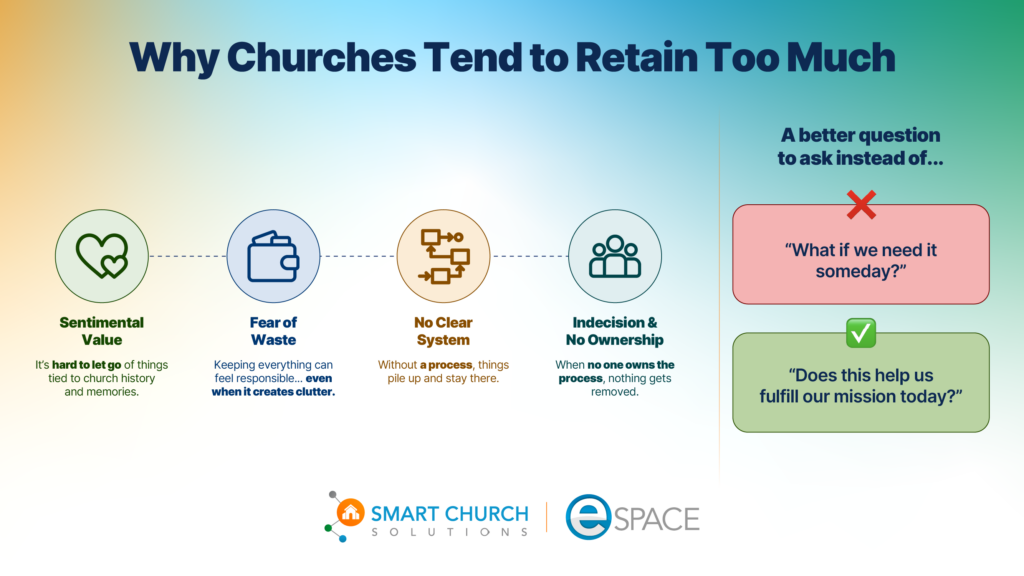
Why Churches Tend to Retain Too Much
There are a few common reasons churches find themselves in this situation:
- Sentimental Value: Churches are rich in history and relationships, so attaching meaning to items is easy. That old pulpit, choir robe, or VBS banner might feel like a piece of the church’s legacy, and letting go can feel like erasing the past.
- Fear of Waste: Churches operate on tight budgets. Throwing something away can feel irresponsible, especially when it might be useful someday.
- No Clear System for Decluttering: Things tend to pile up without a process for evaluating what stays and what goes. The default becomes, “Just put it in storage.”
- Indecision: Many churches don’t have a designated person or team to decide what to keep. When no one is in charge, nothing gets done.
The Impact on Ministry
When retention runs unchecked, it creates more than just a messy storage closet. It affects the church’s ability to function and serve effectively.
- Wasted Time: Staff and volunteers spend countless hours hunting for items buried in the clutter.
- Increased Costs: Cluttered storage spaces are harder to maintain and can even create safety hazards over time.
- Missed Opportunities: When storage areas are full, there’s no room for new tools, resources, or ministries.
- Poor Stewardship: Holding onto unused items takes up valuable space that could be better utilized.
Friends, this isn’t just about logistics; it’s about stewardship. God has entrusted us with our facilities, and it’s our responsibility to manage them wisely.

Moving from Retaining to Releasing
So, how do we fix this problem? It starts with a shift in mindset. Instead of asking, “What if we need this someday?” ask, “Does this item help us fulfill our mission today?”
Here are some practical steps to get started:
Church Storage Tips
1. Release with Purpose
Letting go doesn’t mean being wasteful. Consider donating unused items to another ministry or charity. That stack of old chairs or those extra choir robes could be a blessing to someone else.
What if you move all of your non-essential storage offsite (items you do not use every week)? If people want to store the cantata angel wings from 1966, they will need to load up their vehicle and drive to an off-site location. Place a large dumpster in a judicious location so that when people are transporting those beloved angel wings, they have to drive by and make a conscious decision whether or not to keep moving or to deposit them in the dumpster—just saying.
2. Create Clear Guidelines
Develop a system for evaluating what stays and what goes. For example:
- Has this item been used in the last two years?
- Is it in good condition?
- Does it align with our current ministry needs?
- Is there a definitive and strategic plan to use this item again in the next 1-2 years?
- Establish the cost of the item and how much it will cost to store that item if you were paying for an off-site storage facility. Remember that whether you rent an off-site storage unit or not, there is a cost to the space you use for storage, even if on your own campus.
If the answer to any of the above is no or the cost of storage exceeds the cost of replacement, it’s time to let it go.
Know Your Space: Utilize the Facility Data Sheet
Gain a comprehensive understanding of your facility’s layout and storage capacities. Our free Facility Data Sheet helps you inventory spaces and equipment, aiding in effective decluttering and organization.
3. Schedule Regular Decluttering Days
Make it a habit to clean out storage spaces annually, bi-annually, or even more often. Bring together staff and volunteers to tackle the clutter and celebrate the progress.

4. Empower a Decision-Making Team
Assign a person or team to oversee retention and decluttering. Having someone take ownership ensures that decisions are made consistently and efficiently. What if you gave your facility steward the authority to establish a “use it or lose it” plan for all your storage areas?

Empower your team with eSPACE Work Order & Asset Management. Efficiently assign tasks, track maintenance, and manage assets to keep your church organized and clutter-free. Learn how it works.
5. Prioritize Accessibility
Organize storage spaces so that frequently used items are easy to access. If something is buried in the back of a closet, it’s not serving its purpose.
6. Teach Stewardship Principles
Help your congregation understand the importance of facility stewardship. This isn’t just about tidying up—it’s about honoring God by managing the resources He has given us.
When your congregation understands that your built environment would cost $250-300/SF to build new, and you have a 10’ x 10’ room (100 SF), that space has a value of $25-30,000. Is that level of investment for storage the best financial and facility stewardship?
A Biblical Perspective on Retention
Scripture reminds us of the importance of letting go of what hinders us. Hebrews 12:1 encourages us to “throw off everything that hinders,” while Ecclesiastes 3:6 tells us there is “a time to keep and a time to throw away.”
Holding onto clutter isn’t just a logistical issue—it can also hold us back spiritually. When we release what no longer serves our mission, we make room for what God has planned for the future.
Final Thoughts on Church Storage Problems
Most churches do not actually need more storage space. They need less clutter and better stewardship of the space they already have. When churches address the retention problem instead of simply adding more storage, they create room for ministry to function more effectively.
Every shelf, closet, and storage room comes with a cost. When those spaces are filled with unused furniture, outdated decorations, broken equipment, or items no one has touched in years, valuable ministry space is being consumed by things that no longer serve the mission of the church.
The next time you look at an overflowing storage closet and think, “We need more room,” pause and ask a different question: “What are we keeping that no longer supports ministry?”
Often, the best solution is not expanding storage capacity; it is making intentional decisions about what to keep, what to donate, and what to let go. When churches clear out unnecessary clutter, they improve organization, reduce safety risks, simplify operations, and make better use of the facilities God has entrusted to them.
Good stewardship is not about holding onto everything. It is about creating space for what matters most.