
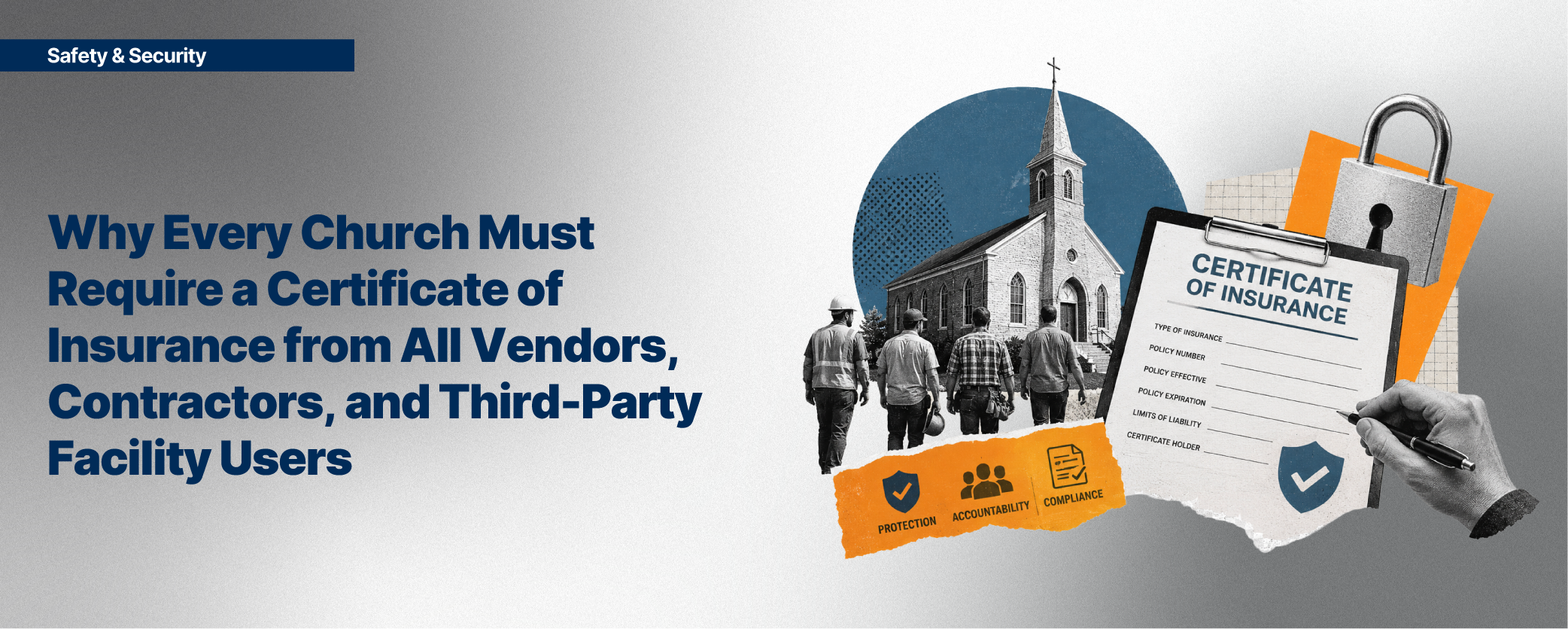
Churches are places of welcome, generosity, and trust. But that spirit of openness—while one of the church’s greatest strengths—can become a serious vulnerability when it extends to contractors and vendors working on church property.
When a painter slips off a ladder, an electrician’s work causes a fire, or a landscaping crew damages a neighboring property, the financial and legal consequences can fall squarely on the church’s shoulders—unless the right protections are in place.
A Certificate of Insurance (COI) is one of the most important—and most overlooked—risk management tools available to church leaders. Requiring a COI from every vendor, contractor, and outside group that sets foot on your property is not a matter of distrust; it is a matter of stewardship. It protects the tithes and offerings your congregation has entrusted to you and your church, shields the church from devastating lawsuits, and ensures your ministry can keep doing what it was called to do.
What Is a Certificate of Insurance?
A Certificate of Insurance is a document issued by a vendor’s or contractor’s insurance provider that summarizes the coverage they carry. It confirms that the individual or company performing work on your property has active insurance—including, at a minimum, general liability and workers’ compensation—and lists the types of coverage, policy limits, and expiration dates.
Critically, a COI should name your church as an “Additional Insured” on the vendor’s policy. This is a specific endorsement that gives the church the right to make a claim under the vendor’s policy in the event of a covered loss. Without this designation, even a COI may offer only limited protection.
The Real Risks of Skipping This Step
Many churches operate informally, especially when using local or long-time vendors they know personally. But familiarity does not equal protection. Here is what can go wrong when a church fails to require a COI:
- Worker injury on church property. If an uninsured or underinsured contractor is injured while working at your facility, your church’s general liability policy may be required to respond—potentially exhausting your limits and leaving the church exposed.
- Property damage. A roofing contractor who accidentally damages your HVAC system, or a plumber whose work floods your fellowship hall, can create enormous repair costs. Without the vendor’s insurance covering the loss, your church absorbs it.
- Third-party bodily injury. A vendor’s equipment or negligence could injure a member of your congregation or a guest. If the vendor has no insurance, your church may be named in the resulting lawsuit.
- Loss of ministry assets. Legal defense costs alone—even when a church ultimately prevails in court—can drain budgets, derail ministry initiatives, and force ministry cutbacks that affect the entire congregation.
It’s Not Just Vendors—It’s Anyone Using Your Facility
Here is a risk that many churches never consider: the outside groups renting or “borrowing” your facility can expose you to the same liability as an uninsured contractor. When a community organization, a school program, a wedding party, a nonprofit, or even another congregation uses your building—whether they pay for it or not—your church can be held legally responsible for incidents that occur on your property during their event.
The list of third parties that commonly use church facilities is long: recovery groups (AA, NA, and similar programs), community sports leagues, tutoring programs, weddings, political gatherings, school co-ops, and neighboring congregations that share space. All of them are welcome. All of them carry risk.
Consider what happens when an attendee at a community group meeting slips and falls in your fellowship hall. Or when a wedding caterer’s equipment causes a kitchen fire. Or when a visiting sports team’s equipment damages your gymnasium floor. If the group using your facility has no insurance of their own—and your church has no Facility Use Agreement requiring one—your policy is likely the only coverage in the room.

The solution is the same as it is for vendors: require a COI. Any third party that is not formally part of your church’s ministry—regardless of whether they are paying rent, using the space as a courtesy, or have been meeting there for years—should be required to provide proof of general liability insurance before they use your facility. Your church should be listed as an Additional Insured on their policy for the duration of their use.
A practical rule of thumb: If the group is not led by, accountable to, and covered under your church’s own insurance policy, they need to bring their own. No exceptions for old relationships, no waivers for nonprofits, no passes for “just this once.” The risk is the same regardless of the circumstances. If your church elects not to require third-party insurance for facility usage, then please consult your carrier to determine if you should increase your coverage or limits of liability.
Common third parties that should always provide a COI:
- Community and civic organizations (AA/NA groups, scouting programs, civic clubs)
- Schools, tutoring programs, and homeschool co-ops
- Wedding and private event parties
- Sports leagues, fitness instructors, and athletic programs
- Nonprofit organizations hosting events or programs
- Guest speakers, performers, or touring ministries
- Other congregations or ministries sharing or renting your space
How a COI Protects Your Church
When properly obtained, a COI with an Additional Insured endorsement provides a powerful layer of liability protection for the church. Here is what that protection looks like in practice:
- Claims go to the vendor’s insurer first. If an incident occurs and your church is named as an Additional Insured, the vendor’s policy responds before yours. This protects your premium rates and policy limits.
- Legal defense coverage. Most liability policies cover legal defense costs in addition to settlements. As an Additional Insured, the church can benefit from the vendor’s legal defense resources.
- Workers’ compensation compliance. Verifying that a vendor carries workers’ compensation insurance ensures that injured employees are covered under the vendor’s policy—not yours—removing the church from that liability chain.
- Vendor accountability. Requiring a COI sends a signal that your church operates professionally. It filters out unqualified or fly-by-night operators who cannot obtain insurance because of poor track records.
What to Require on Every COI
Not all certificates are equal. A COI is only as valuable as the coverage it reflects. When reviewing a vendor’s certificate, verify the following:
- General Liability Insurance: Minimum of $1,000,000 per occurrence / $2,000,000 aggregate is standard for most contractors.
- Workers’ Compensation: Required in virtually every state for any vendor with employees. Sole proprietors may be exempt, but verify this with your attorney.
- Commercial Auto Liability: Required when the vendor drives vehicles on or near your property as part of their work.
- Umbrella / Excess Liability: For larger or higher-risk projects (major construction, roofing, electrical), consider requiring an umbrella policy on top of the underlying coverage.
- Your Church as Additional Insured: Must appear explicitly on the certificate, not just be verbally promised.
- Active Policy Dates: The coverage must remain active for the entire duration of the vendor’s work, not just the day the certificate was issued.
Building a COI Policy for Your Church
Protecting your church starts with making COI collection a non-negotiable part of your vendor onboarding process and your facility use approval process. Here are practical steps church administrators can take today:
- Create a written policy that covers everyone. Document that no vendor, contractor, or outside group may perform work or use church property without first providing a valid COI. This policy should apply equally to paid vendors and free facility users. Have your church board or elder council formally adopt it.
- Collect the COI before work or use begins. Never allow a vendor on-site or a third party into your facility while “waiting” for the certificate to arrive. No COI means no access to the property—without exception.
- Track expiration dates. Maintain a log of all vendor COIs with renewal dates. If a vendor’s policy lapses mid-project, work should halt until updated documentation is received.
- Verify directly with the insurance company. For high-value or high-risk work, call the insurance provider listed on the certificate to confirm the policy is active and the limits are accurate.
- Consult your own insurance agent. Work with your church’s insurance broker to establish minimum coverage thresholds for different types of vendors (e.g., janitorial vs. structural contractors). Your broker can also review COIs for red flags.
- Include COI requirements in all vendor contracts. Any service agreement, facilities use form, or construction contract should include language obligating the vendor to maintain insurance throughout the engagement and to name the church as an Additional Insured.
- Use a Facility Use Agreement for all outside groups. Any third party using your facility—whether paying rent or using the space at no charge—should sign a Facility Use Agreement that explicitly requires them to carry general liability insurance, name the church as an Additional Insured, and provide a current COI before their first use of the space.

This Is Stewardship, Not Suspicion
Some church leaders feel uncomfortable demanding insurance documentation from a trusted vendor or a fellow believer in the community. That discomfort is understandable—but it reflects a misunderstanding of what is at stake. A single uninsured incident can cost tens of thousands, or even millions, of dollars. It can consume reserves set aside for a new sanctuary, a youth center, or a food pantry. It can damage relationships, distract leadership, and undermine public trust in your congregation.
Requiring a COI is not a statement about a vendor’s character. It is an act of faithfulness to the people who give sacrificially to support the ministry. Any reputable, licensed contractor will expect this request—and provide the documentation promptly. If a vendor resists or is unable to provide proof of insurance, that itself is important information about whether they are qualified to work on your facility.
A Final Word for Church Leaders
Church facility management involves constant interaction with outside vendors and third parties—from HVAC technicians and groundskeepers to community groups, event renters, and visiting ministries. Every one of those engagements carries risk. The good news is that managing that risk does not require expensive consultants or complicated legal structures. It starts with a simple, consistent practice: ask for the certificate, verify the coverage, and file it before work or facility use begins.
The churches that handle this well are not just the largest or most resourced. They are the ones where an administrator or a deacon understood that protecting the ministry is part of the calling and put a policy in place before the need arose.
Start today. Review your current vendor list and your facility use schedule. Pull the COIs you have on file. Identify the gaps—both for contractors and for the outside groups regularly using your building. And put a policy in writing so that from this point forward, every contractor who serves your church and every outside group who uses your facility does so with their insurance—and yours—firmly in place.
This blog is for informational and educational purposes only and does not constitute legal or insurance advice. Churches should consult with a licensed insurance professional and/or legal counsel to develop policies appropriate to their specific circumstances and jurisdiction.