


Keeping a church clean takes more than a dedicated team. It takes the right plan. While many churches use square footage as a starting point for determining cleaning staff, that number only tells part of the story. Building layout, room usage, event schedules, and the responsibilities assigned to your custodial team all play a significant role in how many people you actually need.
In this guide, we’ll explain the commonly recommended staffing ratio, discuss the factors that can increase or decrease your cleaning needs, and help you build a realistic staffing plan that keeps your facility clean while making the best use of your resources.
Understanding Staffing Needs
Square footage is a helpful starting point, but it should not be the only factor when determining how many cleaning staff your church needs. Building usage, room types, event schedules, and the responsibilities assigned to your custodial team all affect staffing requirements. Understanding these variables will help you calculate the right number of full-time equivalents (FTEs) and build a cleaning team that can keep your facility clean without stretching resources too thin.
Defining Full-Time Equivalents (FTEs)
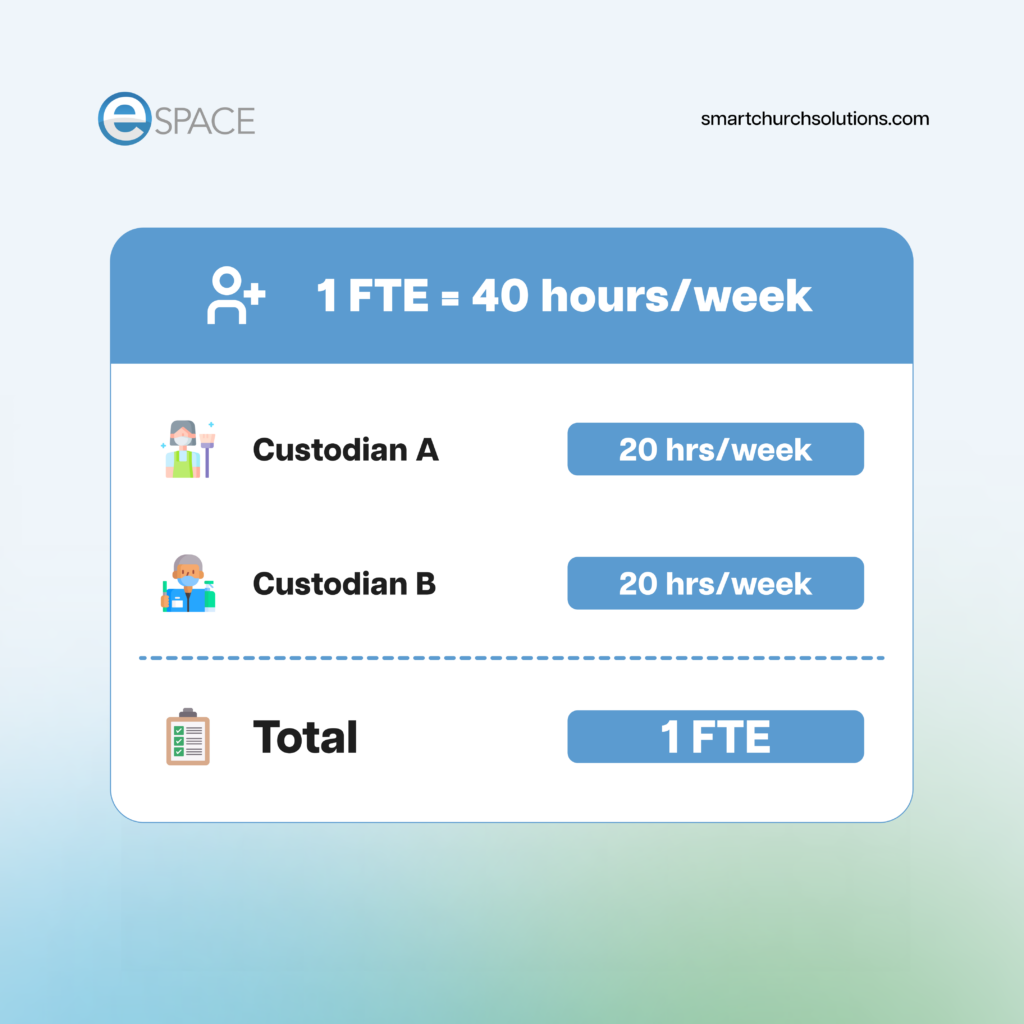
A full-time equivalent (FTE) represents one employee working a full-time schedule, typically 40 hours per week. If your church relies on multiple part-time custodians, you can combine their weekly hours to calculate your total FTEs. Using FTEs instead of headcount provides a more accurate picture of your available staffing and makes it easier to determine whether your cleaning team can adequately support your facility.
Ideal Cleaning Staff Ratios
The standard ratio recommended for maintaining church facilities is one full-time equivalent (FTE) cleaner per 35,000 square feet. This guideline is designed to provide a benchmark for allocating cleaning staff resources effectively, ensuring thorough coverage and maintenance of cleanliness throughout the church premises. This ratio assumes that each cleaner is able to dedicate 100% of their time to cleaning activities.
Map Out Your Maintenance Needs
Use the Facility Data Sheet to catalog square footage, room types, and usage—so your cleaning strategy matches your ministry’s footprint. Download a free copy here.
However, it is important to recognize that this ideal scenario is often not the reality in many church settings. The ratio of one FTE per 35,000 square feet presupposes uninterrupted cleaning duties. In practice, cleaners often engage in various non-cleaning tasks which can significantly diminish their actual cleaning time. These tasks might include setting up for events, assisting with facility maintenance, or performing administrative duties that detract from their primary cleaning responsibilities.
The recommended staffing ratio also does not account for how different areas of your church are used. High-traffic spaces like lobbies, sanctuaries, children’s ministries, and restrooms typically require more frequent cleaning than storage rooms, offices, or other areas with limited use. While one FTE per 35,000 square feet is a helpful benchmark, it should be adjusted based on your building’s layout, occupancy, and ministry activities to ensure every space receives the attention it needs.
Adjusting for Non-Cleaning Duties
Data indicates that approximately 40% of a cleaner’s time might be spent on non-cleaning activities such as setting up rooms or assisting with other tasks. Additionally, factors like paid leave and holidays further reduce effective cleaning time, demanding a reassessment of the one FTE per 35,000 square feet ratio.
Optimize Your Cleaning Team’s Efficiency
With eSPACE Work Order & Asset Management, assign and track tasks to ensure your cleaning staff focuses on what matters most. Want to see it in action? Book a free call here.
Realistic Cleaning Expectations
Facility managers must balance cleaning standards with realistic expectations, acknowledging that not all areas require the same level of cleanliness. High-use areas like kitchens or nurseries may need more frequent attention than lesser-used spaces such as storerooms or seldom-used conference rooms.

Customizing Staffing to Church Activity
Staffing needs can fluctuate based on the church’s schedule of events and the specific areas in use. Efficient scheduling can help allocate cleaning resources more effectively, ensuring high-traffic areas are prioritized and maintained according to need.
Encouraging Responsibility Among All Staff
Encouraging all church staff to participate in maintaining their workspaces can significantly reduce the burden on cleaning teams. Simple actions like disposing of personal trash can aid in keeping the overall facility cleaner and more organized.
Setting Practical Goals
Understanding the dynamics of your church’s operations and the realistic cleaning needs will help you set achievable goals for your cleaning staff. By aligning expectations with practical capabilities, churches can maintain cleanliness effectively without overextending their resources.
Creating a Sustainable Church Cleaning Plan
Determining the right number of cleaning staff for your church requires more than applying a standard square footage ratio. By considering factors such as building usage, high-traffic areas, non-cleaning responsibilities, and event schedules, you can create a staffing plan that supports your facility’s needs while making responsible use of your resources.
A well-maintained church does not happen by accident. Clear expectations, efficient scheduling, and shared responsibility among staff and ministry teams all contribute to a cleaner, safer, and more welcoming environment. With a thoughtful approach to custodial staffing, churches can balance operational efficiency with faithful stewardship of the spaces where ministry happens.