
Some of the best church facility manager stories don’t come from a conference stage. They come from the boiler pit.
Over almost nine years of performing Facility Condition Assessments, our team has walked through churches in nearly every corner of the country, from centuries-old cathedrals to brand-new churches meeting in shopping centers. We’ve climbed onto roofs, opened up elevator equipment rooms, stood in front of million-dollar stained glass, and yes, squeezed past more than a few boilers.
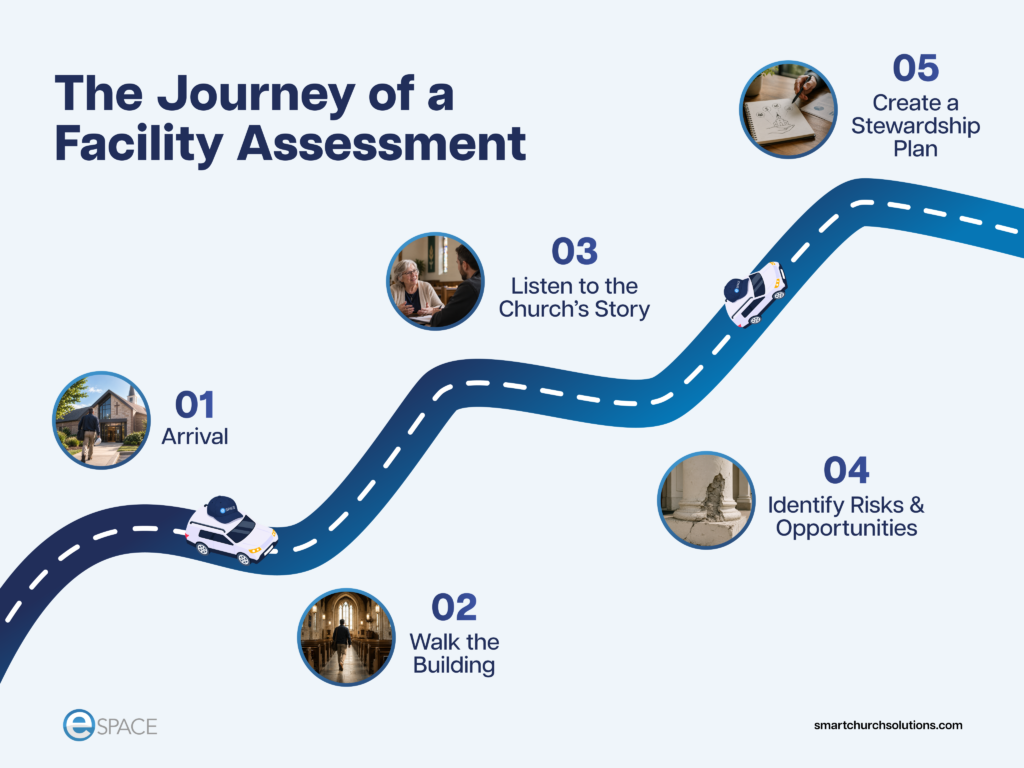
Along the way, we’ve collected stories. Some are about remarkable history hidden in the walls. Some are about craftsmanship we may never see again. A few are cautionary tales. But every one of them taught us something about what it means to steward a church facility well, and about the people who quietly carry that responsibility every week.
Here are several that stuck with us.
When History Lives in the Walls
One of the most meaningful parts of assessing older churches is realizing that the building itself is part of the congregation’s story. A facility isn’t just square footage to maintain. Sometimes it’s a piece of history worth preserving.
Hand-Hewn Cedar Siding and a Rower from The Boys in the Boat
We recently assessed a church in Lake Forest Park, Washington, with siding unlike anything else we’d come across. It was hand-hewn cedar siding, made by hand back in the mid-1960s by a member of the congregation. To this church, that siding is historic and deeply meaningful, which changes everything about how you care for it.
This wasn’t siding you could simply pull off and replace like any other material. It had started taking damage, including from bird attacks, but there was no swapping it out for something off the shelf. So we leaned hard into the idea of historic preservation.
Why was it historic? The man who did the work had been part of the University of Washington rowing team, the crew made famous by the book and film The Boys in the Boat. That connection turned a maintenance question into a preservation question, and it shaped the entire approach to the assessment.
“We Don’t Have a Historic Building, But We Have Historic Features”
That West Coast church led directly to another story. As we talked with churches exploring the idea of a Facility Condition Assessment, a congregation on the East Coast reached out with a thoughtful question. Their building wasn’t on the historic register, but they believed they had historic features, and they wanted to know how we account for those when we evaluate a facility.
“Every church carries something distinctive.”
As it happened, one of the people we were talking with had just read The Boys in the Boat and found real value in it. It helped him make the case that every church has these unique things worth protecting. We were able to show them exactly how we’d handled it at that church out west.
That’s the heart of it: every church carries something distinctive. Part of our job is to understand a congregation’s culture and write a report that leans into those things, that helps them maintain the identity they’re so strongly tied to, rather than flattening it.
The Rockefeller Church Still Heated by Con Edison Steam
In New York City, we assessed a building constructed by the Rockefellers as their home church. To this day, it’s still heated by steam generated at a Con Edison plant, delivered underground through pipes into the church’s system.
That steam costs the church over $100,000 a year to purchase. For years, they’ve been actively trying to convert to a steam system powered by their own boilers and gas, but between New York City, construction, and everything that comes with both, they’ve run into a lot of issues.
Setting the cost aside, witnessing a steam heat system fed from a central plant was one of those things we may never see again in a lifetime. It’s a fascinating piece of how buildings used to be served.
A Meeting House Built by the Brethren in the 1700s
The oldest place we’ve ever assessed sits up in New Hampshire. The original meeting house was built in the late 1700s, a post-frame building constructed by the brethren for a Congregationalist church.
Here’s what’s remarkable. When we assessed it, that original post-frame structure was still within about a quarter inch of square, plumb, and true from when it was built. That’s the quality of the building and the craftsmanship that went into it. Some of the original horsehair plaster had cracked, but honestly, it’s the late 1700s. Nobody’s perfect.
The irony is what drew them to an assessment in the first place. It wasn’t the 250-year-old structure that was failing. It was a two-story addition built in the mid-1980s, connected to the original building, that was completely failing and no longer meeting their needs. Realistically, it should either be fully gutted and redone or removed and replaced. There’s a lesson in that about where quality shows up, and where it doesn’t.
The Pew Abraham Lincoln’s Family Sat In, Rescued from the Trash
In Washington, D.C., we had the opportunity to assess the church Abraham Lincoln attended. His family sat in a pew marked with his placard.
That pew looked completely different from every other pew in the building, and there’s a reason. During a renovation, the church pulled out all the original pews. The priest happened to notice and pulled the Lincoln pew from the trash pile. It very nearly got thrown away.
That same church also has the smallest park in front of it that the National Park Service maintains. These are the kinds of details you only encounter by showing up in person.

How Churches Used to Fund the Mission
Some of the most fascinating church facility manager stories aren’t about buildings at all. They’re about how congregations paid to keep those buildings running, and what that says about their values.
When Pews Were Rented Like Season Tickets
That placard on Lincoln’s pew made a lot more sense to us because of an earlier assessment. A church had handed us their history book and explained how they funded operations back in the 1700s and 1800s: you could rent a pew, a seat, annually.
That was their operating fund for the year, essentially a season ticket. It became your family pew, based on how many seats you needed, and that money is what the pastor used to handle all the maintenance and pay all the bills. Many patrons who could afford a family pew would also pay for two or three additional seats designated for guests or people passing through, so visitors would always have a place to sit.
This was in Augusta, Georgia. Reading through their history book, we saw the number of facilities they helped construct before and after the Civil War. This particular church also had a history of building and providing churches and meeting space for the Black congregations in Augusta. When churches stay focused on the Lord, you see what they’re capable of doing.
The Debt-Averse Church That Stumbled Into Good Stewardship
A church in South Carolina had kept an extensive record of everything they’d done over the years, the kind of history that used to be maintained by dedicated church historians.
What stood out was their aversion to debt. They’d borrow money for a project, then pay it off within five years, insanely quickly. Then they’d start a new project, finance a small part of it, and pay that off within five years too. The goal was always the same: pay it off, get it done.
Without realizing it, they kept up with a lot of their deferred maintenance in the process. As they added on, they were replacing equipment to expand it into the newly designed space. They were never thinking about it as capital replacement or as managing what they had; it just happened because they kept moving through these projects. But it really underscored their sense of stewardship: staying out of debt, staying agile as ministry changed over the years.
Being able to hand them a report that said, essentially, “You’ve been doing this well for a long time, now imagine what you can do with this added information and these tools to carry it into the next generation,” is a pretty cool thing to get to do.
The Craftsmanship and Curiosities We Get to Witness
Traveling the country for assessments means seeing things most people never will. Some of it is breathtaking. Some of it is just wonderfully strange.
Stained Glass Shipped from Germany, and Why Scale Is the Real Story
We’ve had the opportunity to assess multiple cathedrals, and it’s always exciting to see original stained glass, including glass that was fabricated in Germany and shipped over specially for the building.
But here’s the interesting part when you talk about stories from the front lines. It doesn’t matter whether it’s an old cathedral that’s been a bishop’s seat for centuries or a new church built out in a shopping center. From a maintenance perspective, what they run into is fundamentally the same. The deficiencies are the same. It’s just a matter of scale.
When your stained glass is worth $13 million, you have a different scale of window preservation than a church with ordinary windows, but both still have to preserve them. The principle doesn’t change. The zeros do.
Mechanical Switches and Screw-In Fuses in Southern Ohio
In southern Ohio, we got to see an elevator equipment room that operated on mechanical switches and screw-in breakers and fuses. With the cabinet door open, someone rode the elevator, and you could actually watch the switches click as it ran through its operations. It’s the kind of equipment you rarely see still in service.
The Hand-Operated Elevator
Then there was a manually operated elevator, and that doesn’t mean you push a button and it goes up. You get in, it fits one person, and you pull the cage yourself. It certainly wouldn’t meet today’s ADA requirements, but it was a fascinating early effort at reaching people with physical challenges. Someone, decades ago, was trying to solve a real problem for real people.
The Amish Roofer Who Cared About Stewardship
One of the most memorable assessments happened on a roof in the Kansas City area. The roofer was there, which wouldn’t normally be noteworthy, except this man was Amish. He was in his homemade clothes, working alongside his wife, who was wearing her traditional Amish attire.
You don’t usually picture roofing that way. But they did roof restoration, and his wife was hauling up the material they were applying, buckets and buckets of the coating they put down. Watching how they worked, and the work ethic behind it, was fascinating.
The logistics were something else. He doesn’t drive, so he hires a driver for his truck and trailer. He doesn’t operate online. He brings a paper invoice and receives a check. The church found those things genuinely difficult to work around, because they’ve moved into the future; they were printing his work orders and tracking stamps and inventory just to mail him a letter. (Safe to say that vendor wasn’t in the software.)
But they were willing to adapt, because this man was completely about stewardship. He wanted the best for the church, and to him, the best wasn’t tearing off a roof and replacing it with something new that would trigger new insulation and code upgrades. Instead, you can recoat it, reuse the underlayment, and add 20 or even 40 years to the life of the building. His passion was helping the church avoid throwing material into the landfill. Getting to interview him—and then discuss with the facilities team about how they adapted to work with someone who doesn’t use the technology of 2026—was one of a kind.
When an Accident Becomes Preservation
Sometimes the thing that looks like a flaw turns out to be the reason a building survived. You just have to know how to read it.
The Flood That Accidentally Saved a Church’s Brick
At a church in Ohio, a massive flood struck back in the late 1800s or early 1900s. Afterward, they built a large river wall, not quite a seawall, since it was the whole river that flooded. But when the flood hit, it left a stain line on the exterior brick right at the flood level, and stained the interior as well. The only original upper windows that survived were at the balcony level and above, because they were high enough to escape the damage.
The congregation didn’t like that stain line on the brick, so over the years they painted it multiple times. When we were on site, they asked the natural question: what would it take to strip the paint off and expose the original brick again? Everyone loves the idea of getting back to the original.
But we were able to show them sections of the original, unpainted brick near some steps, and how badly it had deteriorated, just from age, the type of mortar, and everything that comes with the years. Because they painted the brick when they did, they actually preserved the original brick and mortar underneath. They don’t have to completely redo everything today.
Our advice? You may not love the color, so change the color. Repaint it. Use a better coating. Paint it brick color if you want. But by painting it, you still have the original brickwork, where most of the buildings around them either don’t have their original brick or have had to invest three to four times the probable replacement value of the building just to preserve it.
“Sometimes an accident ends up preserving something.”
Now they’ve got painted brick and a great little story to bring people in: Why is it painted? Here’s why. Why haven’t we stripped it back to original? Here’s why. Sometimes an accident ends up preserving something, if you recognize it for what it is. The flip side is real too: if they ever decide they don’t want painted brick, they’ll have to invest significant dollars refurbishing and repairing the brick facade. From a stewardship standpoint, comparing the two costs, we wouldn’t touch it. Keep painting it from here on out.
Stories from the Boiler Pit: The Hard Truths We See
Not every story is charming. We could fill another dozen blog posts with the difficult, weird, and downright crazy things we’ve encountered. But a couple of them carry a lesson worth sitting with, especially for anyone who leads a church.
When the Facilities Office Is the Boiler Room
Within a single year, we assessed two different churches where the operations and facilities teams were officed in the same room as the boiler.
One of them, in an older building with all kinds of equipment, had a desk sitting right over one of the pits. People were tucked away in there with all the pumps and all the heat. It was always hot; in the summer there was no air conditioning in the boiler room, and in the winter the boiler was running. The second church literally had a table pushed up against the boiler, using the top of the boiler to store paperwork. That was the office space they’d given their operations team.
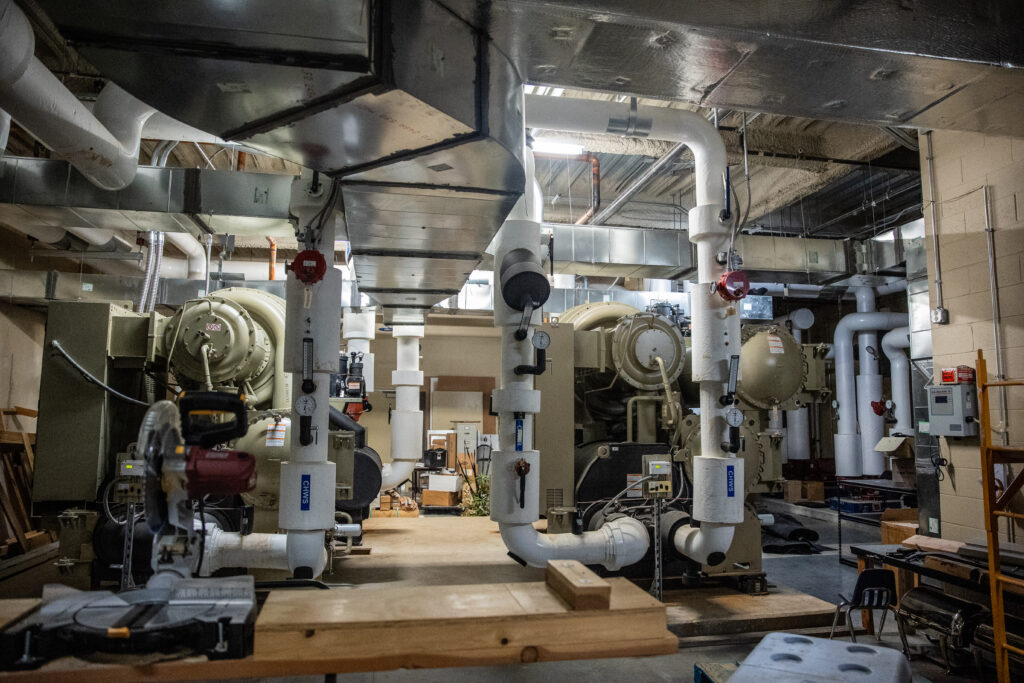
When we find things like that, we’ve started asking a question: if your pastor were meeting a first-time guest after church, would you let them meet in this office? Both churches immediately said no, it wouldn’t be appropriate. So we asked the follow-up: then why is it appropriate for your staff to be here, surrounded by mechanicals?
One of the privileges of being an assessor is asking the kinds of questions that make people reconsider their assumptions about the value their operations teams bring. And it goes deeper than comfort. If leadership won’t meet with the facilities team in their office because it’s a boiler room, and the team always has to come to them instead, that’s a problem worth naming.
The Baptismal No One Was Looking At
At a large church in the Dallas area, we made our way back to the baptismal area, which was, to put it mildly, woefully outdated. Much of the building’s public space had been beautifully remodeled. It was a large, impressive church. But the baptismal area had orange torn carpet, torn linoleum, orange upholstery, and little pull curtains for changing areas. The baptismal itself badly needed cleaning and refurbishment.
You can picture how it happens. The pastor comes in, throws on a pair of waders, hops in, baptizes some folks, and gets out, never really seeing the space. And as an assessor, you struggle with what to say.
The only thing we could come up with was a question: is this the environment where you’d want to welcome people into the family of Christ? This is so much more than a church lobby. This is the moment someone joins the family.
About a year later, their facilities manager showed us photos of a fully remodeled baptismal area. The question had spoken to their pastoral leadership team. It woke them up.
What Every Church Facility Manager Story Has in Common
“Scale changes, but stewardship doesn’t.”
Pull all of these together, and a few threads run through every one.
The first is that scale changes, but stewardship doesn’t. Whether it’s $13 million stained glass shipped from Germany or ordinary windows in a storefront church, the maintenance principles are the same. The deficiencies are the same. Every church, old or new, faces the same fundamental responsibility to care for what it’s been given.
The second is that history and identity are worth protecting, but you have to recognize them first. Hand-hewn siding, a rescued pew, brick preserved by a flood-era paint job: these things matter to a congregation, and a good assessment accounts for them instead of steamrolling them.
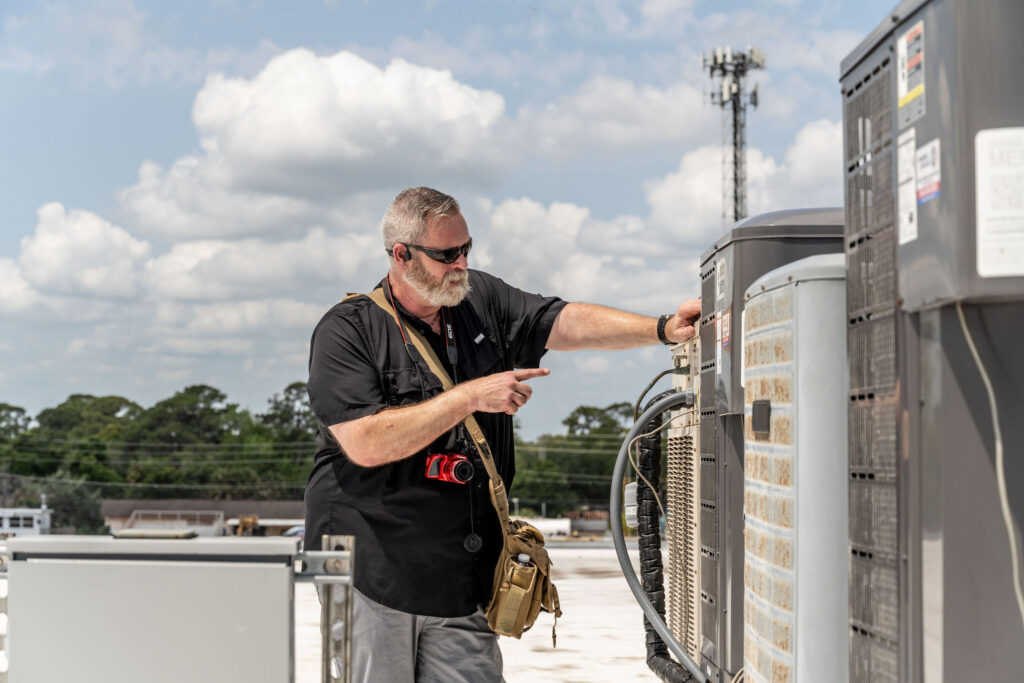
The third is that the people doing this work deserve to be seen. The Amish roofer who wanted to keep material out of the landfill. The operations team crammed in beside a boiler. The facilities manager who took a hard question about a baptismal and turned it into action. These are the quiet stewards who keep the doors open so the mission inside can thrive.
That’s ultimately what a Facility Condition Assessment is about. Not just cataloging what’s broken, but understanding a church’s story well enough to help carry it into the next generation.
If your church has historic features, aging systems, or a facility story of its own, and you’d like to understand what it would take to steward it well for the years ahead, we’d love to talk with you about a Facility Condition Assessment. Every church has these unique things. We’d count it a privilege to help you protect yours.