
Managing facilities at a single church campus is challenging enough. Add multiple locations to the equation, and the complexity multiplies exponentially. How do you coordinate maintenance teams, avoid wasted travel time, standardize operations, and ensure consistent quality across all sites without duplicating efforts or burning out your staff?
The answer lies in strategic planning, centralized oversight, unified systems, and the authority to implement stewardship practices across your entire multi-campus organization.

The Foundation: Centralized Leadership
You Need Someone Overseeing Everything
Multi-campus facility management requires a single point of leadership responsible for coordinating operations across all campuses. Whether the organization uses centralized staff or campus-based teams, there must be one role accountable for overall facility strategy, standards, and execution.
This position is responsible for:
- Making facility-related decisions across all campuses
- Implementing and enforcing organizational standards
- Providing subject matter expertise in facility operations
- Building trust and alignment with campus leadership teams
- Maintaining a seat at the executive leadership level
Common titles for this role include:
- Director of Facilities
- Operations Director
- Multi-Campus Facility Steward
- Director of Facility Stewardship
Without this level of centralized leadership, organizations typically experience:
- Inconsistent maintenance standards across campuses
- Duplicated effort and inefficient use of resources
- Communication breakdowns between locations
- Reactive maintenance instead of planned operations
- Staff burnout, driven by unclear priorities and constant urgency
Two Primary Organizational Models
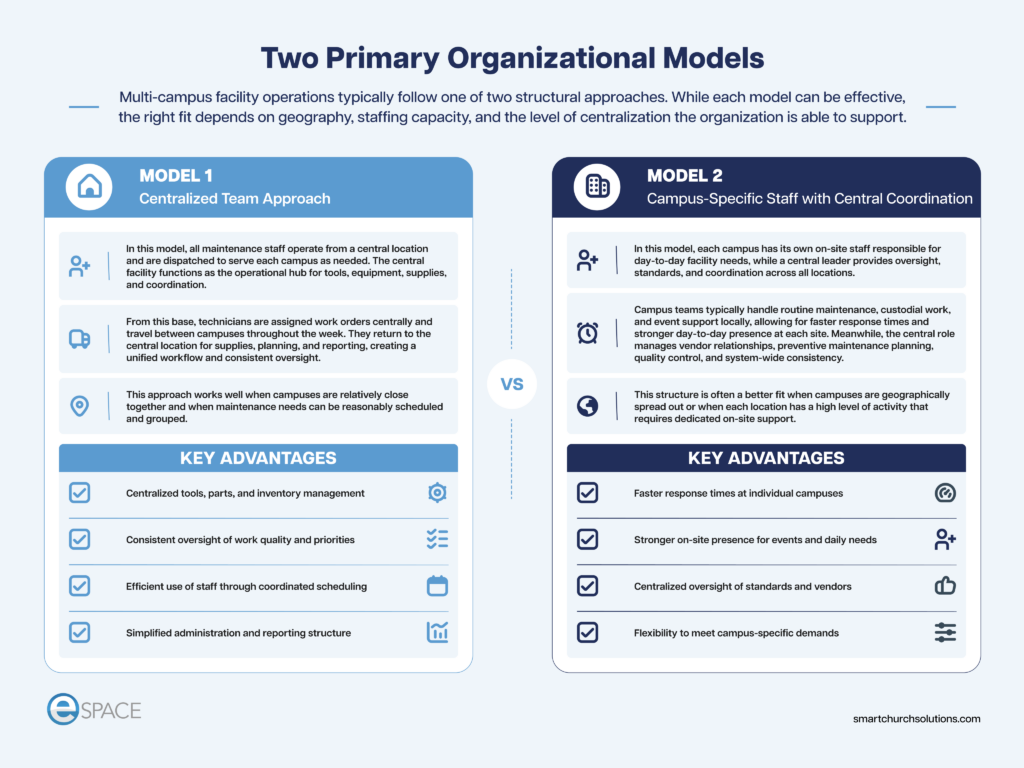
Multi-campus facility operations typically follow one of two structural approaches. While each model can be effective, the right fit depends on geography, staffing capacity, and the level of centralization the organization is able to support.
Model 1: Centralized Team Approach
In this model, all maintenance staff operate from a central location and are dispatched to serve each campus as needed. The central facility functions as the operational hub for tools, equipment, supplies, and coordination.
From this base, technicians are assigned work orders centrally and travel between campuses throughout the week. They return to the central location for supplies, planning, and reporting, creating a unified workflow and consistent oversight.
This approach works well when campuses are relatively close together and when maintenance needs can be reasonably scheduled and grouped.
Key advantages include:
- Centralized tools, parts, and inventory management
- Consistent oversight of work quality and priorities
- Efficient use of staff through coordinated scheduling
- Simplified administration and reporting structure
Model 2: Campus-Specific Staff with Central Coordination
In this model, each campus has its own on-site staff responsible for day-to-day facility needs, while a central leader provides oversight, standards, and coordination across all locations.
Campus teams typically handle routine maintenance, custodial work, and event support locally, allowing for faster response times and stronger day-to-day presence at each site. Meanwhile, the central role manages vendor relationships, preventive maintenance planning, quality control, and system-wide consistency.
This structure is often a better fit when campuses are geographically spread out or when each location has a high level of activity that requires dedicated on-site support.
Key advantages include:
- Faster response times at individual campuses
- Stronger on-site presence for events and daily needs
- Centralized oversight of standards and vendors
- Flexibility to meet campus-specific demands
Travel Time Is Quietly Draining Your Resources
The Hidden Cost of Reactive Maintenance
One of the biggest challenges in multi-campus facility management isn’t maintenance itself—it’s travel time.
Without a clear strategy, maintenance teams often find themselves constantly moving between campuses. A work order comes in from one location, so a technician drives there. Before that task is finished, another request arrives from a different campus. By the end of the week, staff have spent more time on the road than they have completing actual maintenance work.
This reactive approach creates several problems. Productivity drops as travel consumes valuable hours, fuel costs increase, and tools and materials become scattered across multiple locations. At the same time, urgent needs at one campus may be delayed because staff are already committed elsewhere.
Create Dedicated Maintenance Days
Many churches find success by assigning specific maintenance days to each campus. Rather than responding to every non-emergency request immediately, work orders, inspections, and preventive maintenance tasks are grouped together and completed during a scheduled campus visit.
For example, one campus may be serviced on Monday, another on Tuesday, and a third on Wednesday, with additional time reserved later in the week for larger projects, preventive maintenance, or unexpected needs.
This approach allows teams to complete multiple tasks during a single visit, bring the necessary tools and materials once, and significantly reduce unnecessary travel. It also creates a more predictable workflow for campus staff while ensuring that preventive maintenance receives the same attention as repair requests.
Leave Room for Emergencies
Of course, true emergencies still require an immediate response. But when routine maintenance follows a structured schedule, churches can make better use of staff time, improve efficiency, and maintain a higher level of service across every campus.

Coordinate Ministry Schedules Across Campuses
Facility Demands Don’t Stop at the Maintenance Department
One challenge many multi-campus churches overlook is the impact ministry schedules have on facility operations.
When every campus hosts high-attendance events on the same night, facility demands can quickly pile up. Setup teams are stretched thin, custodial crews are responsible for multiple locations at once, and maintenance staff may struggle to respond when issues arise. Even routine needs such as HVAC operation, room setup, and post-event cleaning become more difficult to manage.
Spread Workloads Across the Week
Whenever possible, churches should coordinate programming schedules across campuses to distribute facility demands more evenly throughout the week.
For example, one campus may host youth programming on Tuesday, another on Wednesday, and another on Thursday. While weekend services often need to happen simultaneously, many midweek activities can be scheduled strategically to reduce strain on facility teams and support staff.
This type of coordination requires collaboration between campus pastors, ministry leaders, and facility staff. It also requires an understanding that facility resources are not unlimited. By considering operational impacts during the planning process, churches can create schedules that better support both ministry and stewardship goals.
The benefits extend far beyond the facilities department. Staff is less likely to become overextended, custodial coverage becomes easier to manage, and setup teams can support multiple campuses more effectively. Most importantly, teams can focus on delivering quality support rather than simply trying to keep up with competing demands.
Standardize Wherever Possible
Similar Campuses Are Easier to Maintain
One of the most effective ways to improve efficiency across multiple campuses is through standardization. The more your buildings use the same materials, equipment, and systems, the easier they become to maintain.
While every campus will have unique characteristics, reducing unnecessary variation can save significant time and money over the long term. Areas worth standardizing include:
- Paint colors and flooring materials
- Light fixtures and door hardware
- HVAC equipment and filters
- Plumbing fixtures and replacement parts
- Cleaning products and maintenance supplies
Why Standardization Matters
When campuses share the same finishes and equipment, inventory management becomes much simpler. Instead of stocking multiple types of carpet, paint, filters, light bulbs, and replacement parts, teams can maintain a smaller, more manageable inventory that supports every location.
Standardization also improves maintenance efficiency. Technicians become familiar with the same systems across all campuses, making troubleshooting faster and reducing training requirements. Ordering replacement parts becomes easier, and preventive maintenance procedures can be applied consistently throughout the organization.
The benefits extend beyond maintenance operations:
- Reduced inventory costs
- Faster repairs and troubleshooting
- Simplified staff training
- More efficient vendor relationships
- Better purchasing power through volume buying
There are financial advantages as well. Churches that standardize equipment and supplies are often able to consolidate vendors, negotiate better pricing, and simplify service contracts. Over time, these savings can be substantial.
Beyond maintenance and budgeting, standardization helps create a more consistent experience for members. Whether someone attends one campus or several, familiar finishes, signage, and facility standards reinforce the sense that every location is part of the same church.
Take a Long-Term Approach
Most churches don’t have the opportunity to standardize overnight. Existing campuses often have different finishes, systems, and equipment that have accumulated over many years.
Instead, look for opportunities during renovations, equipment replacements, and capital improvement projects. By making standardization part of your long-term facility strategy, campuses will gradually become more consistent, easier to maintain, and less expensive to operate.
Use Your Size to Negotiate Better Vendor Agreements
Turn Multiple Campuses Into a Competitive Advantage
One benefit of operating multiple campuses is increased purchasing power. When campuses are located within a reasonable geographic area, churches can often negotiate better pricing and service agreements by bundling work across multiple locations.
This approach works particularly well for recurring services such as:
- HVAC preventive maintenance
- Pest control
- Landscaping
- Fire and life safety inspections
- Elevator maintenance
- Janitorial services
Rather than managing separate contracts for each campus, consider consolidating services whenever possible. Vendors often prefer larger, multi-site agreements because they provide more predictable work and reduce administrative overhead.
Reduce Costs Through Better Scheduling
Coordinating vendor visits across campuses can also lead to significant savings.
For example, if a contractor performs HVAC preventive maintenance at three campuses on the same day or during the same week, they may only need to charge one mobilization fee instead of three separate trips. The result is lower travel costs, greater efficiency, and often more favorable pricing for the church.
Beyond cost savings, coordinated scheduling simplifies vendor management and helps ensure maintenance is completed consistently across every location.
Better Data Leads to Better Decisions
Successful vendor management requires visibility into the needs of each campus. Facility leaders should have easy access to equipment inventories, service histories, inspection schedules, and contractor performance information across the organization.
With centralized facility data, churches can identify opportunities to bundle services, compare vendor performance between campuses, and negotiate contracts from a position of knowledge rather than guesswork.
The more complete your facility data is, the easier it becomes to control costs, improve service quality, and make informed decisions across every campus.
The Technology Foundation: Unified Software Systems
Why Multi-Campus Facilities Need Comprehensive Software
Managing multiple campuses without a single system creates blind spots. Assets get tracked in different places, work orders slip through the cracks, and leadership loses visibility into what is happening at each location. Over time, small gaps in communication turn into larger operational inefficiencies.

A unified facility management platform solves this by giving you one source of truth across every campus. In practice, that means supporting the essential capabilities for multi-campus management, such as centralized visibility, consistent workflows, and coordinated scheduling. These typically include the following core functions:
Property and Asset Tracking:
- Separate facility profiles for each campus
- Equipment inventories by location
- Building-specific documentation
- System age and condition tracking
- Maintenance history by campus
Work Order Management:
- Campus-specific work requests
- Centralized visibility across all locations
- Technician assignment by campus day
- Work order analytics by location
- Preventive maintenance scheduling
Event Scheduling:
- Multi-campus calendar visibility
- Resource allocation across locations
- Space management per campus
- Conflict prevention between sites
- Activity coordination tools
Integration Capabilities:
- HVAC control systems
- Electronic access control
- Digital signage management
- Unified reporting across campuses
- Mobile access for distributed teams
The Challenge of Multiple Systems
One of the most common breakdowns in multi-campus environments is the use of different software across departments. Instead of a unified workflow, each team builds its own process, tools, and communication channels.
In practice, this looks like facilities managing work orders in one system, IT using a separate ticketing platform, media requests coming through another tool entirely, and administrative staff relying on spreadsheets or email. Campus coordinators often default to email simply because there is no single intake process.
The result is a fragmented operational picture. Staff are never fully sure where to submit requests, and leadership has no way to see the total workload across all campuses in one place. Work gets entered multiple times—or not at all—because systems don’t talk to each other.
This fragmentation leads to duplicated effort, inconsistent reporting, missed requests, and inefficient resource allocation across the organization.
The Solution: Consolidate to One Platform
Real progress only happens when someone with authority is willing to draw a line and say, “We’re not using 14 different systems. We’re consolidating to one platform that meets the needs of the entire organization.”
That decision has to be supported at the highest level, because consolidation only works when it’s enforced consistently across every department and campus. It requires leadership backing, clear expectations for adoption, and a system capable of handling the full range of operational needs without creating workarounds.
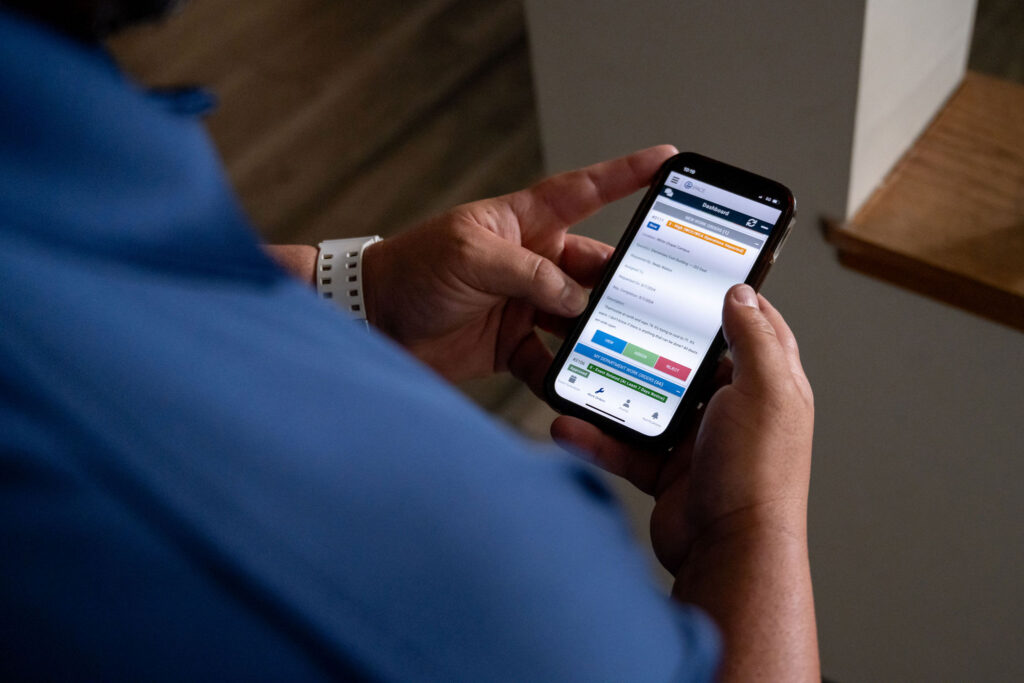
A unified platform should be able to manage everything from facility maintenance requests and IT support tickets to media equipment needs, onboarding tasks, and event setup requirements—essentially any request from initiation through completion.
Just as importantly, it must be paired with training, support, and accountability so that every user actually adopts it as the single entry point for requests.
The “Not Tech-Savvy” Excuse Doesn’t Hold Up
The Adoption Challenge
A common objection to unified facility software is that not everyone is “tech-savvy enough” to use it consistently.
In practice, this argument rarely holds up when expectations and support are clear.
In one facility environment, a team member with very limited education and minimal comfort with technology was still able to fully operate within the system. They logged in daily, reviewed assigned work orders, tracked tasks consistently, and completed responsibilities through the platform over a multi-year period.
The difference wasn’t ability—it was structure.
With a simple login process, a clearly defined workflow, basic training, and accessible support, the system became usable even for someone who would traditionally be considered “not technical.”
What Made it Work
- A simple, repeatable login process
- A central access point for using the system
- Initial hands-on training with patience and repetition
- Ongoing support when questions came up
- A clear expectation that the system was the standard, not optional
The Real Issue is Leadership, Not Capability
Most adoption problems aren’t about whether people can learn the system—they’re about whether the organization is willing to require it and support it.
This is a leadership responsibility:
- Setting clear standards
- Providing the right tools and training
- Reinforcing expectations consistently
- Refusing to maintain parallel “workarounds”
- Expecting improvement over time
If someone can learn to use a smartphone, they can learn to submit and manage work in a facility system with proper support.
What Cannot Continue
What undermines every efficiency gain is allowing exceptions—such as printing work orders for some staff while others use the system. That kind of split process creates duplicate work, reduces visibility, and defeats the entire purpose of consolidation.
Accommodations are appropriate. Parallel systems are not.
Understanding Resource Constraints
Most churches and nonprofit organizations—especially multi-campus ministries—are operating with fewer resources than their facilities actually require to function at a sustainable level.
This gap typically shows up in staffing, funding, and preventive maintenance. Not because of poor management, but because facility needs rarely scale in step with ministry growth.
Importantly, this isn’t just about headcount. It’s about the total capacity required to maintain multiple campuses effectively, whether that capacity comes from staff, volunteers, contractors, or a hybrid approach.
Across most organizations, the result is the same: there are simply more facility demands than available hours to address them proactively.
What This Looks Like in Practice
When resources are stretched across multiple campuses, the strain becomes more visible:
- Travel time begins to consume a significant portion of the workday.
- Preventive maintenance gets delayed in favor of urgent issues.
- Emergency response is slower due to distance and coverage limitations.
- Smaller issues stay unresolved longer and become larger problems.
- Overall quality becomes harder to maintain consistently across locations.
Why Efficiency is Not Optional
Because resources are limited, efficiency isn’t a “best practice”—it’s a requirement for sustainability.
That’s where intentional strategy becomes critical:
- Scheduled campus days to maximize on-site productivity
- Vendor consolidation to reduce duplication and travel costs
- Standardization to simplify maintenance and inventory
- Unified software systems to improve visibility and coordination
- Clear authority to implement consistent facility practices across campuses
Without these systems in place, multi-campus operations naturally drift into reactive maintenance and constant catch-up.
The Authority Question: Making Decisions Stick
The Biggest Hurdle in Multi-Campus Facilities
One of the most common breakdowns in multi-campus facility management isn’t systems or staffing—it’s authority.
When facility subject matter experts don’t have clear decision-making authority, consistency and safety standards become difficult to maintain across campuses. Even well-designed processes begin to erode when recommendations can be easily overridden.
This typically shows up in a few predictable ways:
- Facility guidance being overridden at the campus level
- Safety recommendations adjusted for convenience or scheduling
- Maintenance standards relaxed to accommodate programming needs
- Facility decisions made without operational input
- Compliance considerations deprioritized in the moment

The Tension Between Ministry and Operations
In many organizations, facility guidance is met with a version of the same concern: “If we follow this, it will impact ministry.”
But properly structured facility leadership doesn’t sit in opposition to ministry—it supports it.
The role of facilities is to clearly communicate what is required to operate safely, responsibly, and sustainably. That includes:
- What is needed to maintain safety
- What stewardship requires for long-term care of assets
- What is necessary to protect people and property
- What is required for regulatory compliance
These are not barriers to ministry—they are the framework that allows ministry to happen safely and consistently. These tensions are most visible in practical, everyday decisions:
- Event setups that require more time than the schedule allows
- Facility use that pushes beyond safe capacity limits
- High-risk activities without appropriate safeguards or coverage
- Tight turnaround events that leave no room for proper preparation
In each case, the issue is rarely intent—it’s alignment between operational reality and ministry planning.
The Solution: Clear Authority and a Seat at the Table
Multi-campus facility leadership only works when authority and responsibility are aligned.
That means facility leaders need:
- A defined seat in executive-level decision-making
- Clear authority over facility and safety-related decisions
- Organizational backing when standards are enforced
- Respect from campus and ministry leadership teams
- Consistent reinforcement of facility policies across campuses
Without this alignment, even strong systems struggle to hold.
With it, facility stewardship becomes a stabilizing force for the entire organization—protecting people, preserving resources, and enabling ministry to operate with consistency and confidence across every campus.
Organizational Structure Options
Multi-campus facility management typically operates under one of two primary organizational models. The right approach depends on geography, staffing, and how centralized decision-making is within the organization.
Centralized with Distributed Responsibility
This model works best when all campuses fall under a single organizational structure with unified leadership and decision-making.
In this setup, a Director of Facilities provides oversight for all locations, with campus-level coordinators or staff reporting into that central role. Resources, standards, and budgeting are managed at the organizational level, allowing for consistent execution across every campus.
The strength of this model is consistency. With one set of standards and one decision-making structure, organizations can maintain uniform quality, streamline vendor relationships, and allocate resources more efficiently across all locations. Reporting and accountability are also significantly clearer because everything flows through a single system of oversight.
Distributed with Coordinated Standards
This model is more common in organizations where campuses operate with a higher degree of independence but still share a common brand or ministry alignment.
Each campus typically has its own facility manager or coordinator, with a shared coordination layer that establishes standards, best practices, and organizational alignment. Budgets and day-to-day decisions remain local, while larger facility priorities are guided collaboratively.
This approach offers flexibility, but it introduces complexity. Maintaining consistent quality across campuses requires intentional coordination, shared systems, and ongoing communication. Without that structure, standards can drift, and operational differences between campuses tend to grow over time.
Success in this model depends heavily on shared discipline: commitment to unified standards, regular coordination between campuses, and the use of common tools and systems that keep everyone working from the same information.
The Software Advocacy Requirement
Even with the right structure, standards, and systems in place, multi-campus facility software only works when two specific roles are clearly defined and actively supported.
Technology does not fail in these environments because the software is inadequate—it fails because ownership and enforcement are unclear.
For multi-campus facility software success, you need two distinct leadership functions in place:
Role 1: Software Advocate
This person understands that pen and paper, Excel spreadsheets, and email are not sufficient for managing multi-campus facility operations at scale.
They recognize that effective software:
- Reduces the burden on overworked staff
- Enables better stewardship of time, people, and facilities
- Prevents double-booking and operational conflicts
- Supports structured preventive maintenance programs
- Provides visibility across all campuses in one system
- Creates accountability through consistent documentation
This role is responsible for championing the investment, guiding the selection process, and building organizational buy-in for adoption across every campus and department.
Role 2: Required Use Enforcer
This person holds the authority to ensure the system is actually used—not just implemented.
Their responsibility is to establish and maintain universal adoption by ensuring:
- All departments use a single, unified platform
- No parallel systems (spreadsheets, email chains, side tools) undermine the process
- Internal users have one clear place to submit all requests
- Adoption is complete and consistent across every campus
- Operational standards are enforced, not optional
Without this role, fragmentation quickly returns: multiple systems for the same requests, duplicated tracking through spreadsheets and email, and work orders existing in parallel with unofficial workarounds. The result is lost visibility, reduced efficiency, and a system that gradually loses credibility.
Practical Implementation Strategy
Putting a multi-campus facility strategy into practice requires a phased approach that builds alignment first, then standardization, and finally long-term operational improvement.
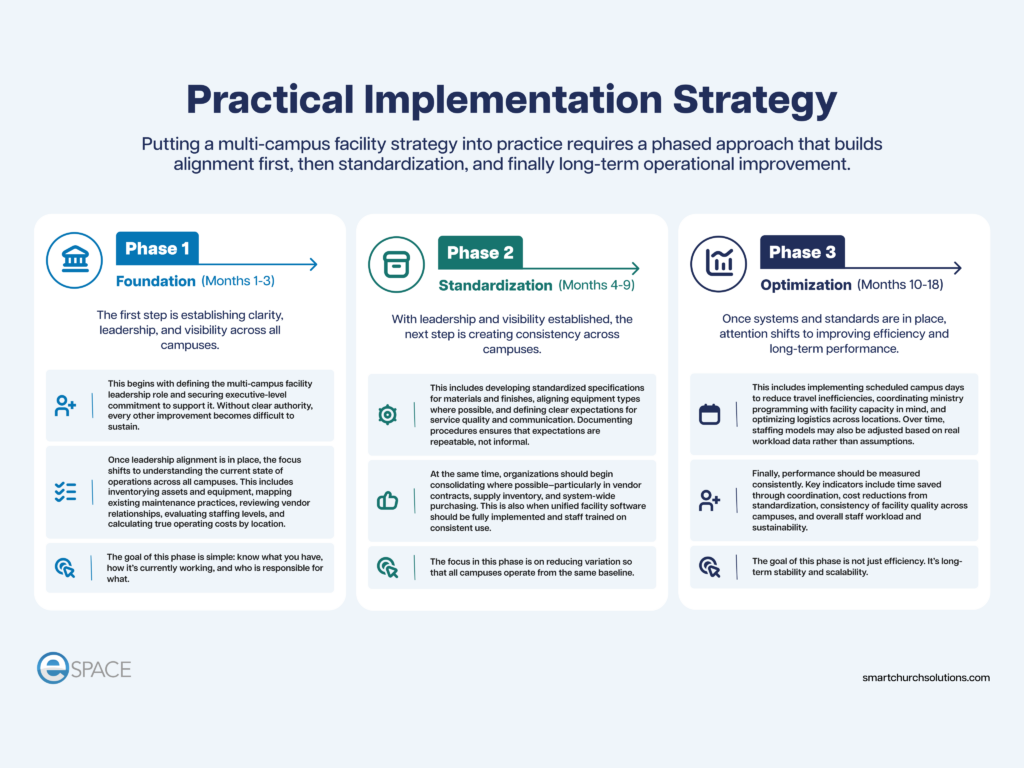
Phase 1: Foundation (Months 1-3)
The first step is establishing clarity, leadership, and visibility across all campuses.
This begins with defining the multi-campus facility leadership role and securing executive-level commitment to support it. Without clear authority, every other improvement becomes difficult to sustain.
Once leadership alignment is in place, the focus shifts to understanding the current state of operations across all campuses. This includes inventorying assets and equipment, mapping existing maintenance practices, reviewing vendor relationships, evaluating staffing levels, and calculating true operating costs by location.
The goal of this phase is simple: know what you have, how it’s currently working, and who is responsible for what.
Phase 2: Standardization (Months 4-9)
With leadership and visibility established, the next step is creating consistency across campuses.
This includes developing standardized specifications for materials and finishes, aligning equipment types where possible, and defining clear expectations for service quality and communication. Documenting procedures ensures that expectations are repeatable, not informal.
At the same time, organizations should begin consolidating where possible—particularly in vendor contracts, supply inventory, and system-wide purchasing. This is also when unified facility software should be fully implemented and staff trained on consistent use.
The focus in this phase is on reducing variation so that all campuses operate from the same baseline.
Phase 3: Optimization (Months 10-18)
Once systems and standards are in place, attention shifts to improving efficiency and long-term performance.
This includes implementing scheduled campus days to reduce travel inefficiencies, coordinating ministry programming with facility capacity in mind, and optimizing logistics across locations. Over time, staffing models may also be adjusted based on real workload data rather than assumptions.
Finally, performance should be measured consistently. Key indicators include time saved through coordination, cost reductions from standardization, consistency of facility quality across campuses, and overall staff workload and sustainability.
The goal of this phase is not just efficiency. It’s long-term stability and scalability.
Common Mistakes to Avoid
Even well-intentioned multi-campus facility strategies can fall apart when a few key missteps go unaddressed. Most of these issues don’t come from a lack of effort. They come from unclear authority, inconsistent systems, or failure to follow through on standardization.
Mistake 1: No Central Authority
- Problem: Each campus operates independently without coordination.
- Result: Duplicated efforts, inconsistent quality, missed opportunities for efficiency.
Mistake 2: Ignoring Travel Time
- Problem: Reactive work order response without scheduled campus days.
- Result: Hours wasted on roads, exhausted staff, and delayed maintenance.
Mistake 3: Allowing System Fragmentation
- Problem: Multiple software systems for different types of requests.
- Result: Confusion, duplicated effort, incomplete visibility, lost efficiency.
Mistake 4: Insufficient Authority
- Problem: Facility leaders can be overruled by campus pastors or program directors.
- Result: Inconsistent standards, safety compromises, staff burnout, resource waste.
Mistake 5: Resisting Standardization
- Problem: Each campus maintains unique finishes, equipment, and procedures.
- Result: Complex inventory, difficult maintenance, training challenges, higher costs.
Conclusion: Strategic Coordination Enables Multi-Campus Success
Managing maintenance across multiple church campuses is complex, but strategic coordination, centralized oversight, and unified systems make it sustainable.
Success requires:
- Centralized leadership with authority to implement standards
- Strategic scheduling that eliminates wasted travel time
- Standardization across campuses for efficiency
- Vendor coordination to maximize value
- Unified software for visibility and control
- Proper authority to make facility decisions stick
- Universal adoption of systems and standards
The multi-campus advantage comes from synergy and good stewardship practices. Organizations that lean into coordination, standardization, and unified operations succeed. Those that treat campuses as standalone entities struggle with inefficiency, inconsistency, and burnout.
Remember: Whether you have two campuses or twenty, the principles remain the same. Establish clear leadership, eliminate wasted effort, standardize operations, leverage technology, and ensure your facility leaders have the authority to implement responsible stewardship practices.
The complexity of multi-campus facility management is real, but with the right structure, systems, and support, you can maintain excellent facilities across all locations while being good stewards of the resources God has entrusted to your care.

Multi-Campus Facilities Quick Reference
Essential leadership structure:
- Director of Facilities overseeing all campuses
- Campus coordinators or subject matter experts at each site
- Authority to implement standards across the organization
- Seat at the executive leadership table
Critical coordination strategies:
- Scheduled campus days to eliminate wasted travel
- Ministry programming coordinated across campuses
- Standardized finishes, equipment, and supplies
- Multi-campus vendor contracts and negotiations
Technology requirements:
- Unified software for all campuses
- Work order management with multi-site visibility
- Event scheduling across all locations
- Integration with HVAC, access control, and signage
- Mobile access for distributed teams
Efficiency multipliers:
- Standardization reduces inventory complexity
- Vendor consolidation reduces costs
- Scheduled service days minimize travel
- Software adoption eliminates duplicate systems
- Authority to implement enables consistency