
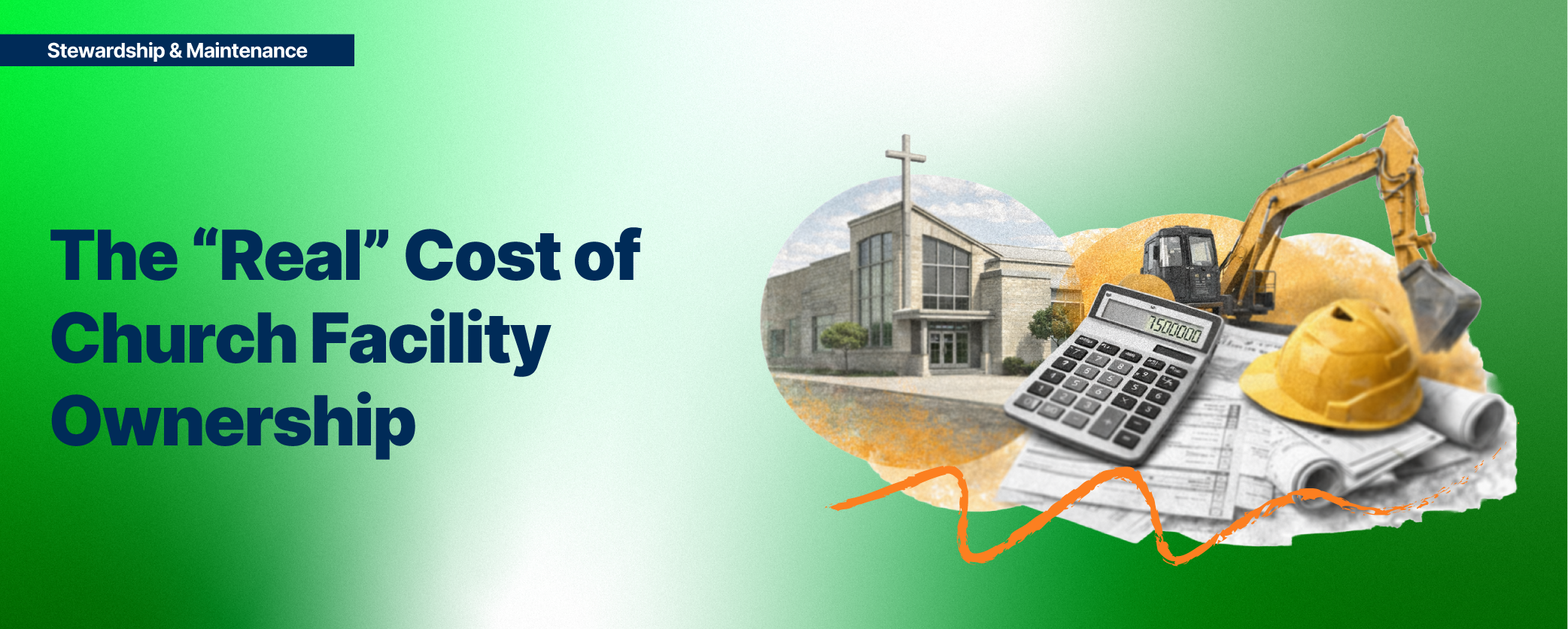
The most expensive mistake churches make isn’t overbuilding. It’s underestimating what it costs to own.
Each year, millions are spent on new or renovated church buildings, but few leaders truly account for what it costs to operate, maintain, and sustain them. In this guide, we’ll uncover what facility ownership really costs and how proper planning, budgeting, and stewardship can keep your ministry financially healthy for decades.
Zoom Out: The Actual Cost of Owning a Church Facility
Let’s look at a realistic example.
Assume a new 30,000-square-foot church facility built for $7.5 million. The church finances $6 million through a 15-year loan at 7%, but aggressively pays it off in six years. Even with early payoff, the cost of borrowing money totals approximately $2 million.
That is only the beginning.
According to industry benchmarking from the International Facility Management Association (IFMA), facilities of this type can expect to spend up to $7.50 per square foot annually on janitorial services, utilities, and general maintenance. In addition, capital renewal and replacement costs often average up to $3.00 per square foot annually when properly reserved.
Using a blended estimate of $9.50 per square foot, a 30,000-square-foot facility requires approximately $285,000 per year in operational and capital reserve funding.
Over a 40-year life cycle—even using modest inflation assumptions—that annual obligation grows to approximately $21.5 million.
Construction may feel expensive. Ownership is exponential.
Zoom In: What Do The Costs Mean
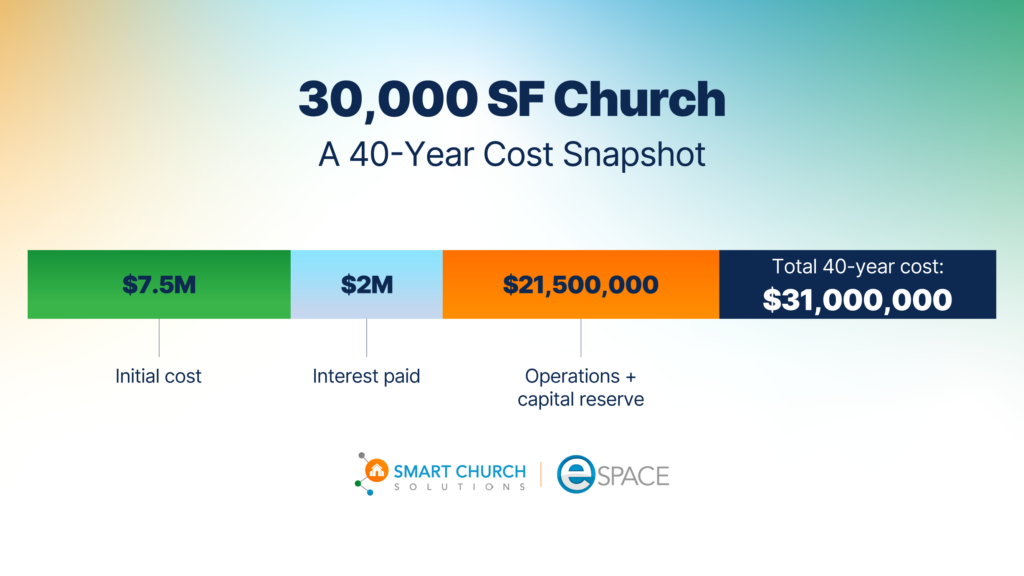
40-Year Total Cost of Ownership (30,000 SF Facility)
- Initial Construction: $7,500,000
- Cost of Money: $2,000,000
- Operations + Capital Reserve: $21,500,000
- Total: $31,000,000
That total alone is significant—but the breakdown is what truly changes perspective.
- ~24% Construction
- ~6.5% Cost of Money
- ~69% Operations & Capital Expenditures
In other words, nearly 70% of the total cost of owning a church facility occurs after construction is complete.
And this does not include insurance. Depending on location and other variables, insurance can add $40,000–$60,000 annually, resulting in well over $2,000,000 across the same 40-year period.
The implication is clear: while construction often receives the most attention, the long-term cost of operating and sustaining the facility represents the majority of the financial commitment.

What Costs More: Building a Church or Operating a Church?
Operating—by a landslide.
The ongoing expenses of maintenance, energy, capital renewal, and deferred repairs silently consume budgets. According to ChurchTrac, most churches spend 20–30% of their total budget on facilities and operations, while Tithe.ly’s research shows an average of 23% allocated to facilities annually.
These numbers show that the majority of financial weight happens after the ribbon-cutting. Unfortunately, few churches plan for that reality.
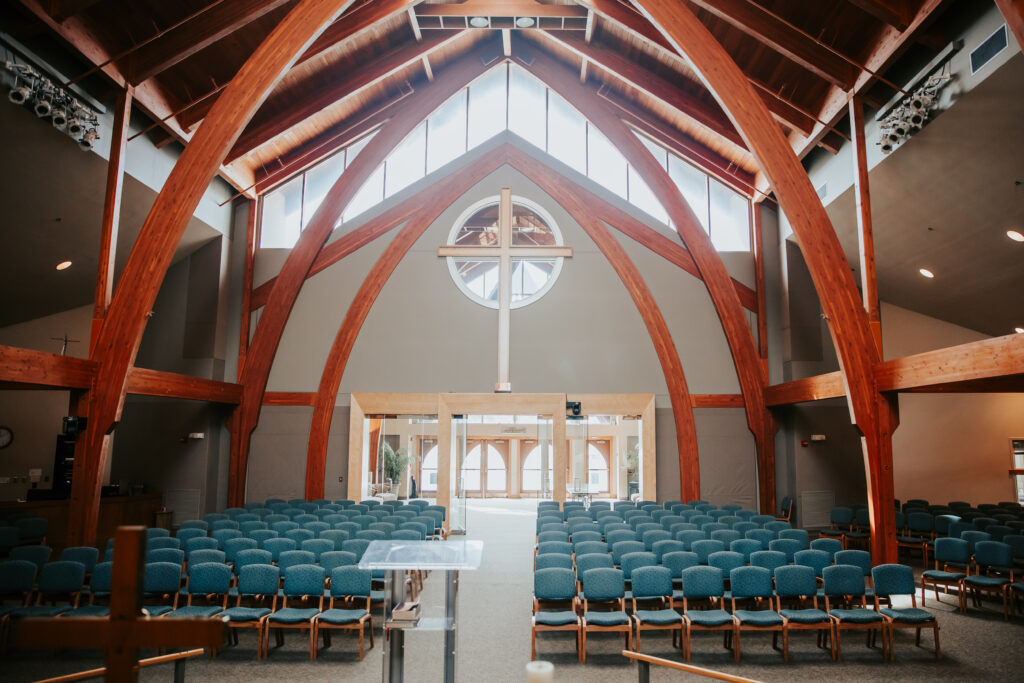
Some facility owners become frustrated when they see 7% instead of 5% for design fees or if the construction partner charges 6% instead of 3%. The fees that comprise only 3% of the total costs of ownership seem so important at the time, but the decisions and directions suggested and put in place are what will be a part of your building for a long time. It’s essential we fix our focus on the actual cost of facility ownership—not the initial.
Church Facility Stewardship and Ownership
Facility stewardship isn’t about cutting costs—it’s about maximizing ministry through wise, sustainable management. True stewardship includes every phase of a building’s life cycle, not just its grand opening.
1. Purposeful Facility Planning
Before building, ask:
-
Does this facility truly serve our mission and vision?
-
Can we sustain its operational costs?
-
What is the long-term financial impact on our congregation?
Good planning includes life cycle projections and reserve allocations—not just square footage and seating capacity.
2. Proper Facility Development
Wise construction includes financial stewardship. Invest in design that reduces operational costs, not just upfront expenses. Energy-efficient systems, durable materials, and flexible layouts lower long-term expenditures.
As McKnight Group reports, churches should currently budget $275–$325 per square foot for new construction—but more importantly, they must plan for decades of maintenance that follows.
3. Proactive Facility Management
Reactive maintenance is costly. Studies show churches that use proactive facility management software (CMMS) reduce operational costs by 35–45% compared to those without structured systems.
A comprehensive maintenance plan ensures your HVAC, roofing, and lighting systems reach full life expectancy—saving thousands annually.
4. Transparent Budgeting and Reserves
Your operating budget should include clear line items for maintenance, capital reserves, and replacements. Our team at Smart Church Solutions recommends budgeting $4.50–$7.00 per square foot annually for operations, plus $1.00 per square foot toward future capital reserves.
The Real Cost of Neglect
Deferred maintenance always costs more later. Churches that fail to plan for lifecycle replacements often find themselves facing large, unplanned capital crises—roof failures, HVAC replacements, water damage—all of which divert resources from ministry.
“Facility stewardship is not about bricks and mortar; it’s about mission readiness.” — Tim Cool
A building should serve ministry, not strain it.
Building for the Long Game
When you understand the full cost of ownership, your perspective changes:
-
You design smarter.
-
You budget with foresight.
-
You operate with stewardship.
Investing in the long game ensures your building remains a ministry tool for generations—not a financial burden.
Free Resource: Church Facility Budgeting eBook
When you understand the full cost of church facility ownership, your perspective changes. Construction is no longer the finish line; it is the starting point of a decades-long financial commitment. The real stewardship challenge is not raising the capital to build, but sustaining the discipline to operate, maintain, and renew that facility for generations.
If you are serious about aligning your building with your mission—not just financing a project—you need a long-term budgeting framework that accounts for lifecycle costs, capital reserves, and operational sustainability. Churches that plan beyond the ribbon-cutting position themselves to protect ministry impact rather than react to financial strain.
To help you think strategically about church maintenance budgeting, capital reserve planning, and total cost of ownership, our team at Smart Church Solutions created a Church Facility Budgeting eBook designed specifically for executive pastors and church leaders. It will help you move from short-term construction thinking to long-term stewardship planning.
Because a building should support ministry for decades—not compete with it.