

Does the word “accountability” make your shoulders tense up or make you defensive? It does mine. For most of us, it doesn’t feel like a gift — it feels like the moment after something has gone wrong, when someone shows up to ask what happened.
Dr. Henry Cloud, in his new book Your Desired Future, argues that this distorts what accountability was always meant to be. And when you trace the idea back far enough, you land somewhere familiar: the Parable of the Talents. We have discussed this many times over the past 15+ years, but this time we are going to add some additional context for church leaders.
We’ve Been Entrusted
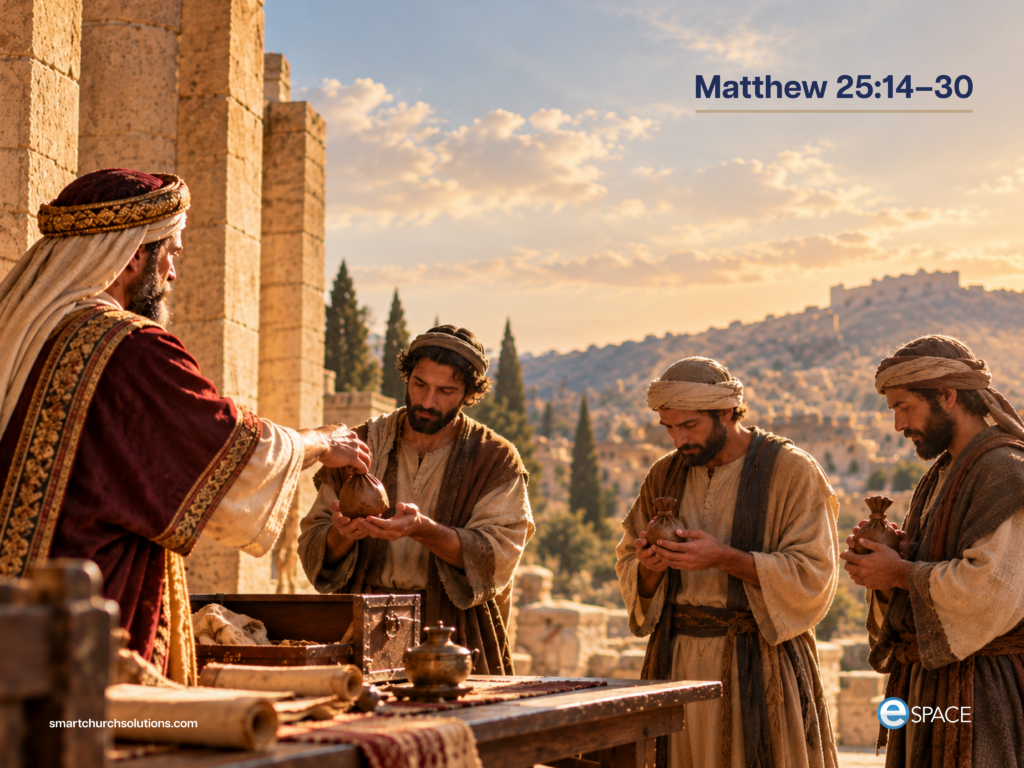
In Matthew 25:14–30, a master prepares to leave on a journey. Before he goes, he entrusts his servants with talents — not so they’ll bury them in the ground and keep them safe, but so they’ll invest them and grow something. When he returns, he doesn’t ask, “Did you avoid every risk?” He asks, “What did you do with what I gave you?”
That’s the original shape of accountability. Someone entrusted with something valuable, answering for how it was stewarded, not out of fear, but because the relationship and the mission actually matter to them.
Cloud arrives at the same picture from a different angle. He traces the word “accountability” back to its root meaning: to “reckon or calculate,” used whenever someone has been entrusted with something by someone else — money, a duty, a responsibility, an office. In his words, it is “a relational word, grounded in the relationship and for the relationship,” and its purpose is to make sure all is good, mutually reinforcing, and generative.
Two very different sources. The same core truth.
Every One of Us Has Been Entrusted
Look around your organization and you’ll see the parable playing out in real time. Someone has been entrusted with a relationship. Someone else with a budget, a facility, a team, a ministry area, a number on a dashboard. Like the servants in the parable, none of us were handed these things to bury them safely and avoid risk. We were handed them to move something forward.

Cloud illustrates this with a picture from the book: a commercial pilot flying a full plane to LAX. She’s been entrusted with something serious — the lives of everyone on board — and she’d never take off without her instruments and accountability systems in place: air traffic control, her flight crew, her checklists, her instrument panel. All of it exists to answer one ongoing question: is she doing what she agreed to do? When she drifts off her assigned altitude or heading, she gets a signal — an instrument warning, a call from the tower — and she corrects immediately. She doesn’t get defensive or make excuses. She says, essentially, “Thank you — I appreciate it. Correcting now.”
That’s not weakness. That’s what it looks like to actually care about the outcome more than you care about being seen as flawless.
Three Details Worth Noticing in the Parable of the Talents
I have always loved the Parable of the Talents. I have heard numerous sermons, teachings, podcasts, and the like on the Matthew 25 passage. But before we move on, there are three details in the parable itself that are worth slowing down to notice: long trip, entrusted, and while he was gone.
Long Trip
This was not a sprint. It was a marathon. The master was not just going around the corner. He was going to be gone for a while, and he needed his “people” to step up.
Entrusted
The servants were not entitled to this responsibility. It was entrusted to them. To entrust something means to put it into someone’s care or protection. And at the root of that word is trust. You can’t entrust something if you do not trust the person you give the responsibility to.
While He Was Gone
The master was not going to be there to look over their shoulder, watching every move. He was going to be absent, and the servants were expected to act faithfully while he was gone.
These same principles have significant implications for church facility stewardship. Stewardship, at its simplest, means taking care of someone else’s stuff. If we believe that everything ultimately belongs to God and that we are here to steward what He has given us, then the Parable of the Talents gives us a helpful framework for thinking about our facilities.
- Long trip means facility stewardship is a long-term venture. Maintenance, management, capital planning, and life-cycle decisions all require us to think beyond the immediate problem and toward the future.
- Entrusted means we are not entitled to our ministry facilities. They have been entrusted to us to steward.
- While he was gone means we are responsible for how we care for what has been placed in our hands. We are not waiting for someone else to step in and manage it. We have been entrusted with the responsibility.
“Again, the Kingdom of Heaven can be illustrated by the story of a man going on a long trip. He called together his servants and entrusted his money to them while he was gone.” Matthew 25:14 NLT
Reframing the Word
Most of us flinch at “accountability” because we’ve only ever experienced it as retroactive and punitive — something that shows up after a failure, to assign blame. Cloud’s argument is that this is a hijacking of the real thing. Done right, accountability is forward-looking and empowering. Its only job is to help us get “there” — to help us accomplish a future we’ve already agreed we want.
That reframe fits the parable perfectly. The master in the story isn’t an auditor combing through paperwork looking for a mistake to punish. He’s inviting his servants into a shared future built on trust. Accountability, in both Cloud’s language and the parable’s, is trust made visible — a way of saying, I gave you this because I believe in what we can build together, and I want to know how it’s going so we can get there.
What This Means for How We Lead
Somewhere along the way, a lot of us learned to treat accountability like a performance review, something that shows up once a year to catalog what went wrong. But the healthiest teams, like Cloud’s pilot in the cockpit, build something different: tight, fast, everyday feedback loops where drifting off course gets noticed and corrected quickly, without shame and without hiding.
Not a courtroom. A cockpit.
So here’s the question worth carrying into your next team or leadership meeting, your next one-on-one, your next facility walkthrough. It’s not just, “What have I been given?” It’s the question both the parable and the pilot point to.
The Takeaway
The Parable of the Talents reminds us that accountability is not primarily about avoiding failure or answering for what went wrong. It is about faithfully stewarding what has been entrusted to us. Whether it is a ministry, a team, a budget, or a church facility, we have been given something valuable and called to do something with it.
Like the servants in the parable, we are responsible for how we steward what God has placed in our hands. Healthy accountability helps us stay aligned with that responsibility, make adjustments when needed, and keep moving toward the future we have been entrusted to build.
The Parable of the Talents
14 “For it will be like a man going on a journey, who called his servants and entrusted to them his property. 15 To one he gave five talents, to another two, to another one, to each according to his ability. Then he went away. 16 He who had received the five talents went at once and traded with them, and he made five talents more. 17 So also he who had the two talents made two talents more. 18 But he who had received the one talent went and dug in the ground and hid his master’s money. 19 Now after a long time the master of those servants came and settled accounts with them. 20 And he who had received the five talents came forward, bringing five talents more, saying, ‘Master, you delivered to me five talents; here, I have made five talents more.’ 21 His master said to him, ‘Well done, good and faithful servant. You have been faithful over a little; I will set you over much. Enter into the joy of your master.’ 22 And he also who had the two talents came forward, saying, ‘Master, you delivered to me two talents; here, I have made two talents more.’ 23 His master said to him, ‘Well done, good and faithful servant. You have been faithful over a little; I will set you over much. Enter into the joy of your master.’ 24 He also who had received the one talent came forward, saying, ‘Master, I knew you to be a hard man, reaping where you did not sow, and gathering where you scattered no seed, 25 so I was afraid, and I went and hid your talent in the ground. Here, you have what is yours.’ 26 But his master answered him, ‘You wicked and slothful servant! You knew that I reap where I have not sown and gather where I scattered no seed? 27 Then you ought to have invested my money with the bankers, and at my coming I should have received what was my own with interest. 28 So take the talent from him and give it to him who has the ten talents. 29 For to everyone who has will more be given, and he will have an abundance. But from the one who has not, even what he has will be taken away. 30 And cast the worthless servant into the outer darkness. In that place there will be weeping and gnashing of teeth.’