


Starting as a church facility manager can feel overwhelming. You’re responsible for maintaining buildings, managing events, coordinating volunteers, and supporting ministry activities, often with limited resources and staff who don’t fully understand what you do.
If you’re just stepping into this role, the guidance in this article comes from experienced facility managers who’ve navigated the challenges you’re about to face. Here’s what you need to know to not just survive, but thrive in church facility management.
1. Don’t Live in Isolation. Build Your Support Network
The Reality of Church Facility Management
Church facility management can be isolating. Very few people—especially those supervising you—fully understand the scope of what you carry each day. You’re balancing competing priorities, unrealistic timelines, tight budgets, and expectations that often conflict with one another.
You will experience tension. You will face misunderstandings about your role. And you will occasionally feel like you’re the only one in the room who sees the risk or the resource gap. That’s why isolation is so dangerous in this role.
Why Networking Matters
A strong professional network outside your church is not a luxury—it’s a lifeline. When you connect with other facility managers, you gain perspective. You realize you’re not crazy. You’re not alone. And the challenges you’re facing are not unique to your building.
A network gives you advocates who understand your world, people you can call when you’re wrestling with a difficult decision, and professionals who can share what worked (and what didn’t) in similar situations. Instead of constantly reacting and surviving, you gain the bandwidth to think strategically and accomplish something meaningful.
Where to Find Your Network
Start locally. Reach out to facility managers at nearby churches and suggest coffee once a month or once a quarter. Many regions already have informal networks. You may just need to ask around to find them. These relationships often become the most valuable support system you’ll have in this role.
You should also consider joining the National Association of Church Facilities Managers (NACFM). Unlike broader organizations such as the International Facility Management Association (IFMA), which focus primarily on corporate and institutional facility pressures, NACFM understands the unique dynamics of ministry environments. Members support one another regularly, share resources, and genuinely understand the relational and spiritual pressures that come with working in a church.
In addition, online communities—such as church facility manager Facebook groups, virtual roundtables, and webinars—can provide access to experienced professionals willing to share insights and advice.
The bottom line is simple: you cannot do this job well in isolation. Build your network early. You’ll need it sooner than you think.
2. Maintain Your Spiritual Foundation
Why This Matters More Than You Think
Church facility management is not just an operations role. It is ministry. You stepped into this position because of a calling, not simply because of your skill set. That distinction matters, especially when the pressure increases.
The daily demands of maintaining buildings, supporting events, managing expectations, and solving problems can slowly push your spiritual life to the margins if you’re not intentional. But your devotional life is not optional in this role. It is your stabilizer.
- When staff members call in crisis.
- When a difficult conversation lands in your office.
- When criticism catches you off guard.
- When expectations rise, but resources don’t.
Your spiritual foundation is what keeps you steady.
Times Will Get Tough
This isn’t pessimism; it’s reality. There will be seasons when demands exceed resources. There will be moments when sacrifices affect your personal time, your family, or your health. There will be situations where the extraordinary becomes expected.
If your identity becomes rooted only in performance, productivity, or problem-solving, you will eventually burn out. But when your identity is anchored in Christ, you gain perspective. You remember who you ultimately serve. You remember why you said yes to this role.
Don’t neglect the Word. Don’t neglect prayer. Don’t neglect the rhythms that keep you grounded. The operational pressures of this position are real, but so is the grace available to sustain you through them.
The most effective facility stewards are not just technically competent. They are spiritually anchored. And in this environment, that foundation is not a luxury. It is essential.
3. Build Relationships with Your Leadership
Invest in Your Boss Relationship
Take time to develop a genuine relationship with your direct supervisor (often an executive pastor or operations director):
Go beyond work conversations:
- Regular lunches to talk about life
- Shared activities outside the office
- Personal connection that builds trust
- Understanding each other’s perspectives
Real example: One facility manager spends a couple of hours weekly at the gun range with his boss. They shoot, talk, and have lunch. This creates the relational foundation for critical work conversations later.
Why This Investment Pays Off
When you need support, you can say, “I really need you to have my back here,” and they will.
When they need to redirect you, there’s enough respect for them to say, “Okay, I got your back, but don’t go this far.”
You learn where to draw lines on taking stands, so you don’t become the person who says no all the time.
You become a problem solver who can say: “That may not be the greatest idea, but I can help you think of something that will get your end result without increasing liability or causing safety concerns.”
4. Stop Accomplishing the Extraordinary Every Time
The Unsustainable Trap
First and foremost: Stop accomplishing the extraordinary every day. This may be the most important advice you receive.
At times, you will need to allow something to fail, especially when the only way it could be accomplished as scheduled requires:
- Extraordinarily long hours from you
- Extraordinarily long hours from your team
- No indication that this pressure won’t happen again
Why Facility Stewards Burn Out
Too often, facility stewards sacrifice because of their heart and desire to serve:
- Time from family
- Time from self
- Time from relationships
- Health and well-being
This is not healthy, nor is it sustainable.
The Resource Reality
Your resources are finite: time, personnel, and budget.
You cannot operate at full capacity indefinitely. When you try, something critical gives way, and it’s usually the invisible but essential work:
- Preventive maintenance
- Compliance responsibilities
- System development
- Documentation
When those areas are neglected, today’s urgency becomes tomorrow’s crisis. Sustainable stewardship requires margin. Without it, you’re not leading, you’re just reacting.
Learning to Push Back Respectfully
Pushing back is not saying “no.” It’s saying, “Help me understand how we can accomplish this with our current resources.” It’s communicating clearly that planning ahead is not optional. It’s necessary.
Sometimes, the healthiest thing you can do for your church is allow the consequences of poor planning to surface. Not out of spite. Not out of neglect. But out of reality.
When everything always works out at the last minute, no one feels the pain of poor planning—except you.
Creating a Planning Culture
Encourage events to be planned 3–6 months in advance. With proper notice:
- Resources can be allocated appropriately
- Personnel schedules can be managed
- Budget implications can be addressed
- Workloads can remain balanced
When you have time to plan, you can accomplish what’s asked without sacrificing everything else. Extraordinary effort should be reserved for true emergencies, not normal operations.
Sustainable stewardship is not about being a hero every day. It’s about building systems and expectations that make heroics unnecessary.
5. Become a Subject Matter Expert About Your Building
Non-Negotiable Knowledge
There’s no room for not knowing:
- How much square footage do you maintain
- Where electrical panels are located
- Where gas lines and meters are positioned
- Where service enters the building
- What type of service do you have
- Where backflow preventers are installed
- All critical system locations
Why This Matters
You cannot accomplish what you’re tasked with if you don’t understand your resources. Your building is your primary resource.
The Complexity Challenge
Many facilities are built over multiple time frames, which means:
- Multiple water meters are possible
- Multiple gas meters potential
- More than one electrical meter
- Different systems serving different areas
- Varied equipment ages and types
You have to know where everything is and how it works.
The Documentation Process
This takes time:
- Learning the systems
- Documenting locations
- Understanding how things connect
- Mapping utilities and equipment
Start immediately: This knowledge becomes invaluable during emergencies and when planning projects or maintenance.

6. Develop Systems for Everything
Why Systems Matter
If you want consistency, you need systems. Church facilities are too complex to run on memory, personality, or good intentions. The consistent accomplishment of your responsibilities requires repeatable processes that work every time, trainable procedures your team can follow, and reproducible methods that do not depend solely on you.
If a task can only be done correctly when you are present, you do not have a system. You have a dependency. Systems reduce errors, protect quality, and make delegation possible. More importantly, they make your role sustainable. Without systems, you will always be reacting. With systems, you can lead.
The System Development Process
Don’t just jump in and start working:
Step 1: Look at what it takes to accomplish the task
- Break down the components
- Identify required resources
- Understand timing requirements
Step 2: Research best practices
- How do other facilities handle this?
- What does the industry recommend?
- What are the safety requirements?
Step 3: Write it down
- Document the procedure
- Create step-by-step instructions
- Note required materials and tools
Step 4: Practice it
- Test the procedure
- Identify problems or gaps
- Refine as needed
Step 5: Evaluate and adjust
- Did it work as intended?
- What improvements are needed?
- How can it be simplified?
Time Spent on Systems Is Not Wasted
Developing systems and training takes time upfront, but:
- Saves enormous time long-term
- Enables delegation to others
- Creates consistency in quality
- Reduces errors and rework
- Makes your role sustainable
The longer you’re a facility steward, the more this investment pays dividends.
7. Leverage Technology and AI Tools
Modern Tools for Modern Challenges
You are stepping into facility management at a time when powerful tools are readily available. Use them. Artificial intelligence platforms such as ChatGPT can significantly reduce the administrative burden that overwhelms many new facility managers. What used to take hours can often be accomplished in minutes with the right prompts and refinement. Uses of AI can include:
Writing Standard Operating Procedures:
- Dictate what you need to accomplish
- AI builds comprehensive SOPs quickly
- Edit and refine for your specific situation
- Transform hours of writing into minutes
Preparing for leadership meetings:
- Organize your thoughts verbally
- AI converts to cogent talking points
- Tailored to your target audience
- Professional presentation ready
Problem-solving and planning:
- Brainstorm solutions to challenges
- Research industry standards
- Understand equipment or systems
- Generate maintenance schedules
Setting Boundaries for Administrative Work
One of the most common struggles for facility managers is finding uninterrupted time for administrative responsibilities. Planning, documentation, budgeting, reporting, and system development rarely feel urgent compared to a leaking pipe or a last-minute event request. As a result, they get pushed aside.
One experienced facility steward solved this by establishing a clear boundary. He designated one day each week to work remotely and focus exclusively on administrative tasks. During that time, the phone ringer was off, interruptions were minimized, and his attention was directed toward planning, documentation, and long-term system development.
It was a bold boundary, but it proved effective. His productivity increased, preventive planning improved, and reactive stress decreased.
For new facility managers, establishing this type of rhythm early is often easier than trying to implement it years later. During onboarding, have a direct conversation with leadership about protected time for administrative work. If you do not create margin intentionally, the urgent will always consume the important.
8. Educate Your Church About Commercial Maintenance
The Knowledge Gap
Most staff, volunteers, and committees influencing your workflow do not have a reasonable understanding of:
- Commercial maintenance requirements
- Commercial cleaning standards
- Time requirements for facility work
- Resources needed for proper care
The House Cleaning Lens Problem
Most people view cleaning through their home experience:
- One to two bathrooms
- 10-12 people visiting weekly
- Manageable with household methods
They don’t understand commercial scale:
- 10-12 restrooms
- 30-50 fixtures
- 2,000-5,000 people weekly
- Different methods required
- Different emphasis needed
- Professional standards necessary
Telling the True Story
If you want your church to understand what it actually takes to operate a commercial facility, you must tell the true story. And the true story is told with data.
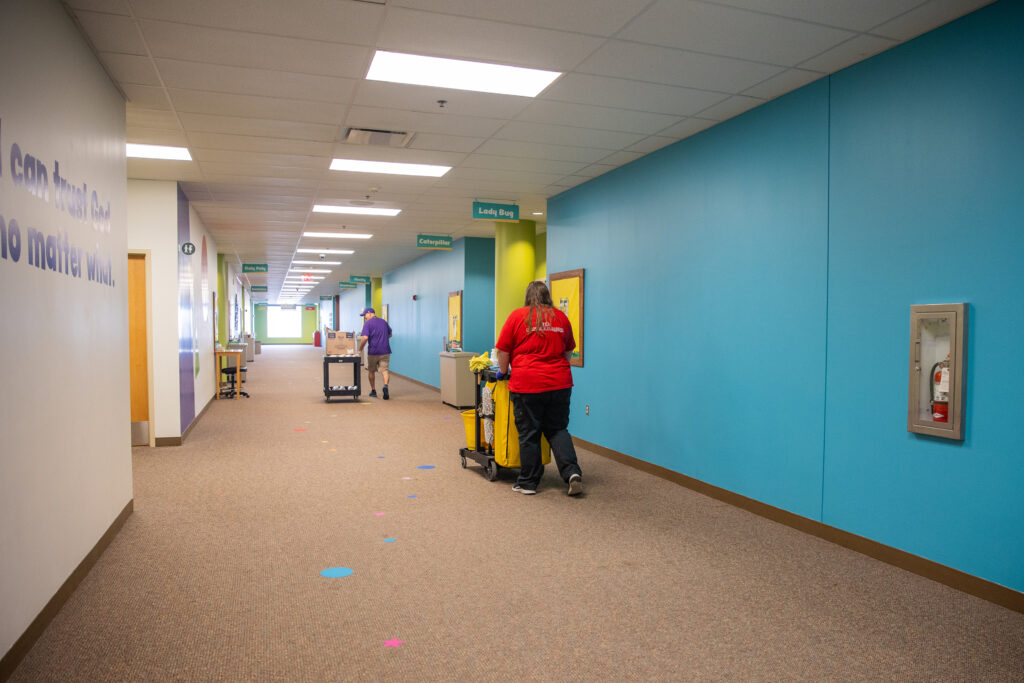
Start by collecting objective information. Document how long tasks actually take. Track the resources being used. Measure the total square footage being maintained. Calculate the person-hours required to clean, maintain, and support the building each week.
Once you have the data, communicate it clearly. Show leadership what it truly takes to operate the facility at a commercial standard. Explain the difference between residential expectations and commercial requirements. Demonstrate where resource gaps exist and how they affect outcomes.
When you move the conversation from feelings to facts, the discussion changes. Instead of defending why something was not accomplished, you are educating decision-makers on what is realistically required. Data does not eliminate constraints. But it creates clarity. And clarity is the foundation for responsible stewardship.
When Things Need to Fail
Sometimes failure is the teacher: In some cases, allowing something to stumble or fail is the only way people recognize they need to rethink something.
This isn’t negligence. It’s demonstrating realistic resource constraints when your warnings aren’t heard.
Remember: It’s a Commercial Building
Yes, it’s a house of worship. Yes, it’s where we gather. Yes, to all those things. But it is a commercial building.
Established methods exist for:
- Maintenance practices
- Cleaning standards
- Operations procedures
- Safety requirements
These are based on years of research. Your job is to help others understand and accept this reality.
9. Educate Yourself Continuously
Resources for Learning
Smart Church Solutions website:
- Information on best practices
- Guidance on commercial cleaning standards
- Time requirements for various tasks
- Research and data for decision-making
Online communities:
- Facebook groups for church facility managers
- Others in the field are happy to answer questions
- Shared experiences and solutions
- Real-world advice
Industry associations:
- NACFM training and resources
- Conferences and workshops
- Certification programs
- Continuing education
AI and online research:
- ChatGPT for industry standards
- Equipment manufacturer resources
- Building system documentation
- Maintenance best practices
10. Adopt the Right Software Systems
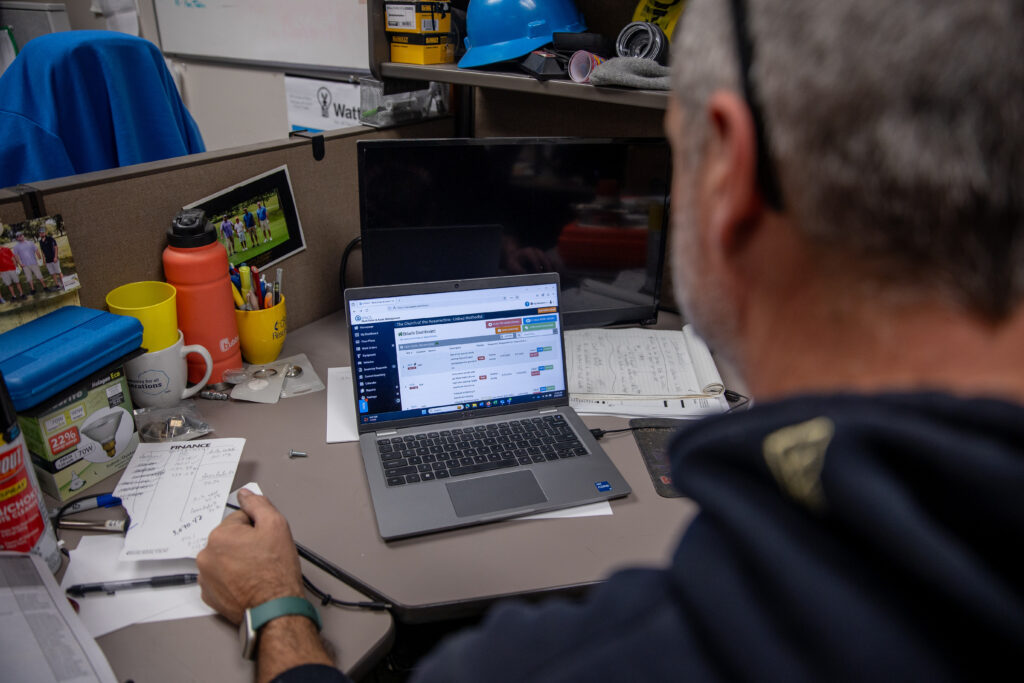
As you begin developing systems, you need reliable ways to document and manage them. It is not enough to create procedures. You must be able to record them, retain critical details, track completed work, and plan future tasks in a structured way.
At a minimum, many facility managers start with Word documents, note-taking apps, or spreadsheets. These tools can provide basic organization and may work temporarily during transition.
The problem is that this approach is limited. Static documents do not provide real visibility into completed work. Spreadsheets rarely support long-term preventive maintenance planning. Notes stored in personal folders do not create institutional continuity.
As your responsibilities grow, fragmented documentation becomes a liability. What feels manageable at first quickly becomes disorganized, difficult to track, and nearly impossible to hand off to the next person.
Software is not about complexity. It is about control, clarity, and continuity.
The Better Solution: CMMS and Event Scheduling
Computerized Maintenance Management Systems (CMMS), combined with event scheduling software, provide:
Work order management:
- Track all maintenance requests
- Document completed work
- Plan preventive maintenance
- Analyze patterns and trends
- Know what’s occurring in your facility
- Plan resources appropriately
- Coordinate with facility needs
- Manage space usage
Integration capabilities:
- HVAC control systems
- Access control
- Digital signage
- All systems are working together
The Time Savings Impact
A quality CMMS does more than organize work. It multiplies capacity. When implemented correctly, many churches experience time savings equivalent to one full-time employee. In some cases, the efficiency gain approaches one and a half full-time positions. That impact comes from automating routine tasks, centralizing communication, reducing duplication, and eliminating the time lost searching for information.
This matters because you will typically be understaffed and underfunded. That is not an exception in church facility management. It is the norm.
In that environment, time-saving tools are not optional upgrades. They are operational necessities. The right system does not just make you more organized. It gives you back hours you do not currently have.
Choosing the Right System
The best system is the one you’ll actually use.
Common problems with facility software:
- Too many choices and complexity (focus on every nut and bolt)
- Too narrow focus (only events, or only maintenance)
- Not designed for church environments
- Requires extensive customization
What works best for churches:
- Comprehensive system covering events and maintenance
- Designed specifically for church facility stewards
- Integration between scheduling and work orders
- User-friendly interface that staff will adopt
Systems like eSPACE provide church-specific solutions that address both event scheduling and facility maintenance in one integrated platform.
Why Software Adoption Matters Beyond Your Tenure
You will not be in this role forever. At some point, you will move on, retire, or transition to something else. What you leave behind matters.
Without proper systems in place, your successor starts from scratch. There is no documented history, no organized procedures, no clear record of what has been maintained and what has been deferred. Institutional knowledge walks out the door with you.
With the right software in place, the next facility manager inherits clarity instead of confusion. They gain access to complete facility history, documented procedures, equipment maintenance records, and established workflows. They can see patterns, understand decisions, and build on the foundation you created rather than rebuilding it.
That is true stewardship. You are not only caring for the building. You are protecting the continuity of the role for whoever comes next.
11. Understand You’re Typically Understaffed and Underfunded
The Universal Reality
Across the country, church facility managers operate with constrained resources. Research and field experience consistently show the same pattern: the workload exceeds staffing levels, budgets rarely match long-term needs, and time pressure is constant.
This is not unique to your church. It is the structural reality of church facility management.
Understanding that truth changes how you interpret your challenges. The tension you feel is not personal failure. It is the result of operating within a limited capacity.
Why This Matters
When you accept this reality, you can set realistic expectations, communicate limitations clearly, and prioritize with greater discipline. You stop measuring success by whether everything gets done and start measuring it by whether the right things get done.
Most importantly, you avoid internalizing the impossible. You are not failing because you cannot accomplish everything. You are working within constraints by design.
Working Within Constraints
Effective facility leaders focus first on critical safety issues and life-safety compliance. They protect preventive maintenance because it prevents larger, more expensive crises later. They build systems that multiply their effectiveness rather than relying on personal effort. They invest in education and relationships that create understanding and support.
You cannot eliminate constraints. But you can lead wisely within them.
Conclusion: Setting Yourself Up for Success
Starting as a church facility manager is challenging, but you do not have to figure it out alone. The wisdom of experienced facility stewards points to a few consistent principles.
Build strong relationships. Invest in your network, your leadership, and your spiritual foundation. Set healthy boundaries so you are not constantly accomplishing the extraordinary at the expense of sustainability. Develop systems that create repeatable, trainable processes rather than dependence on personal effort. Know your building thoroughly and become the subject matter expert on the facility you steward.
Leverage technology to multiply your effectiveness. Educate your church about commercial facility realities. Commit to continuous learning. Choose tools and software that preserve knowledge and create continuity beyond your tenure.
Most importantly, remember that you are not just maintaining buildings. You are enabling ministry, supporting the mission of the church, and stewarding resources entrusted for Kingdom purposes. That perspective gives meaning to the pressure.
You will face difficulties in this role. Every facility manager does. But with the right foundation, relationships, and systems in place, you can thrive.
Build margin early. Implement strong systems. Surround yourself with wise counsel. And resist the temptation to be a hero every day.
Sustainable stewardship is a marathon, not a sprint.
Quick Action Steps for Your First 90 Days
Week 1-2: Build Relationships
- Identify local church facility managers
- Join NACFM or other professional organizations
- Connect with your direct supervisor for regular meetings
- Establish your spiritual rhythm and boundaries
Week 3-4: Learn Your Building
- Document all utility locations
- Map electrical panels and shutoffs
- Identify all mechanical systems
- Create a basic facility reference guide
Week 5-8: Develop Initial Systems
- Write the first SOPs for critical tasks
- Establish work order process
- Create a preventive maintenance calendar basics
- Set up basic documentation methods
Week 9-12: Implement Technology
- Research and select CMMS/event scheduling software
- Begin data entry and system setup
- Train initial users
- Start tracking all work systematically
Beyond 90 Days
- Continue education and networking
- Refine systems based on experience
- Build a planning culture with 3-6 month horizons
- Focus on sustainable practices, not heroics